




 View Count:27
 Date:2026-11-17
How should spring mould be handled? By getting the blackening residue and the water out first: rinse to neutral after the bath, dry in steps until the wire carries no moisture, and slip 0.1-0.2 g iHeir-D gas-phase sheets between the layers as the bundle is built. A black oxide film is porous, and the bath salts and water stay in the pores; bundle it unwrinsed and white bloom appears in days, with mould behind it. This article covers the rinse criterion, the drying steps and the sheet count.
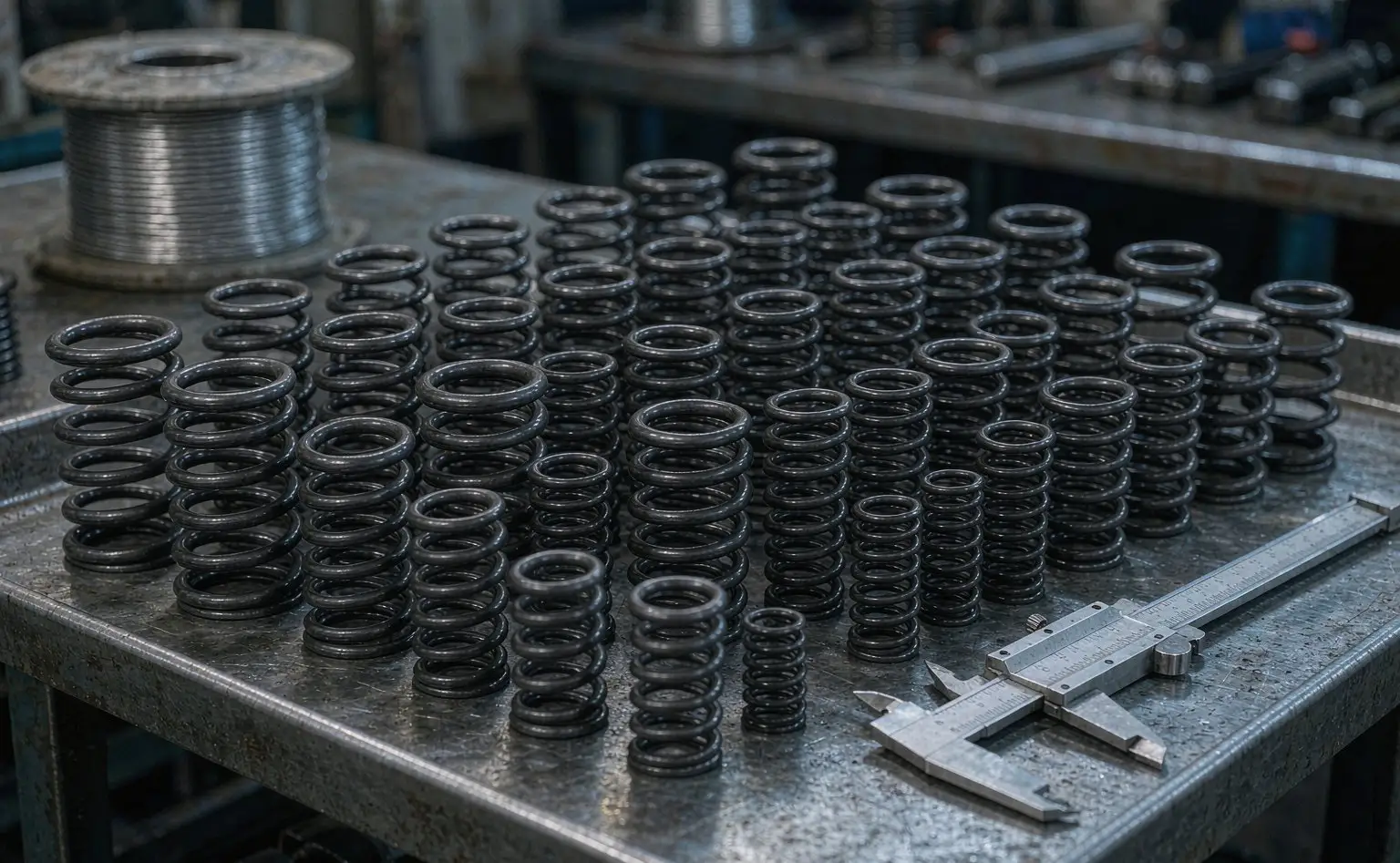
1. Where spring mould comes from: film pores, water inside the bundle, packing
Springs are coiled, heat treated, blackened or phosphated, rinsed, dried, bundled and packed. The wire does not grow mould; growth sits on the residue held in the film pores.
Film pores come first. Blackening forms a porous magnetite film a few microns thick from an alkaline bath. The pores leave the bath full of liquor, and a thin rinse leaves alkali and nitrite inside to bloom to white salt, with mould on top.
Water inside the bundle comes second. The coils touch once bundled, so neither air nor cloth reaches between them, and moisture there dries far more slowly than on a loose spring; the outside dries while the inside stays wet, so growth runs from the inside out.
Packing and container come third. Cartons, bags and pallets take up moisture, and in a 20 ft container the wall condensate settles into the bottom boxes; over 30-45 days at sea it swings more than ten degrees.
Each source needs its own answer: pores by rinsing and drying, the layers by a sheet and airing, the packing by sheets and sticks. A spring can only be protected.
2. How to dry after blackening: rinse to neutral, then step the temperature up
A sheet cannot hold back a pore still full of liquor.
Rinse to neutral. Dip in a hot rinse after the bath, then in running clean water, and test the final rinse with pH paper; 6.5-7.5 means clear, higher means alkali is left. Rinse the springs loose, not as a whole bundle dipped and lifted.
Then step the temperature up. Run the oven from 60-70℃ up to 90-100℃ over 20-40 minutes, longer for thick wire and heavy bundles. Straight in at 120℃ skins the outside and traps the vapour in the pores.
Read the spring, not the clock. Leave them 10 minutes on an open rack; dry means no damp feel, no beads between coils, not tacky. A hot spring hides moisture, so check it after it cools.
Do not substitute an air blast for drying. Air moves surface water and drives the pore water deeper; circulate hot air in the oven instead.
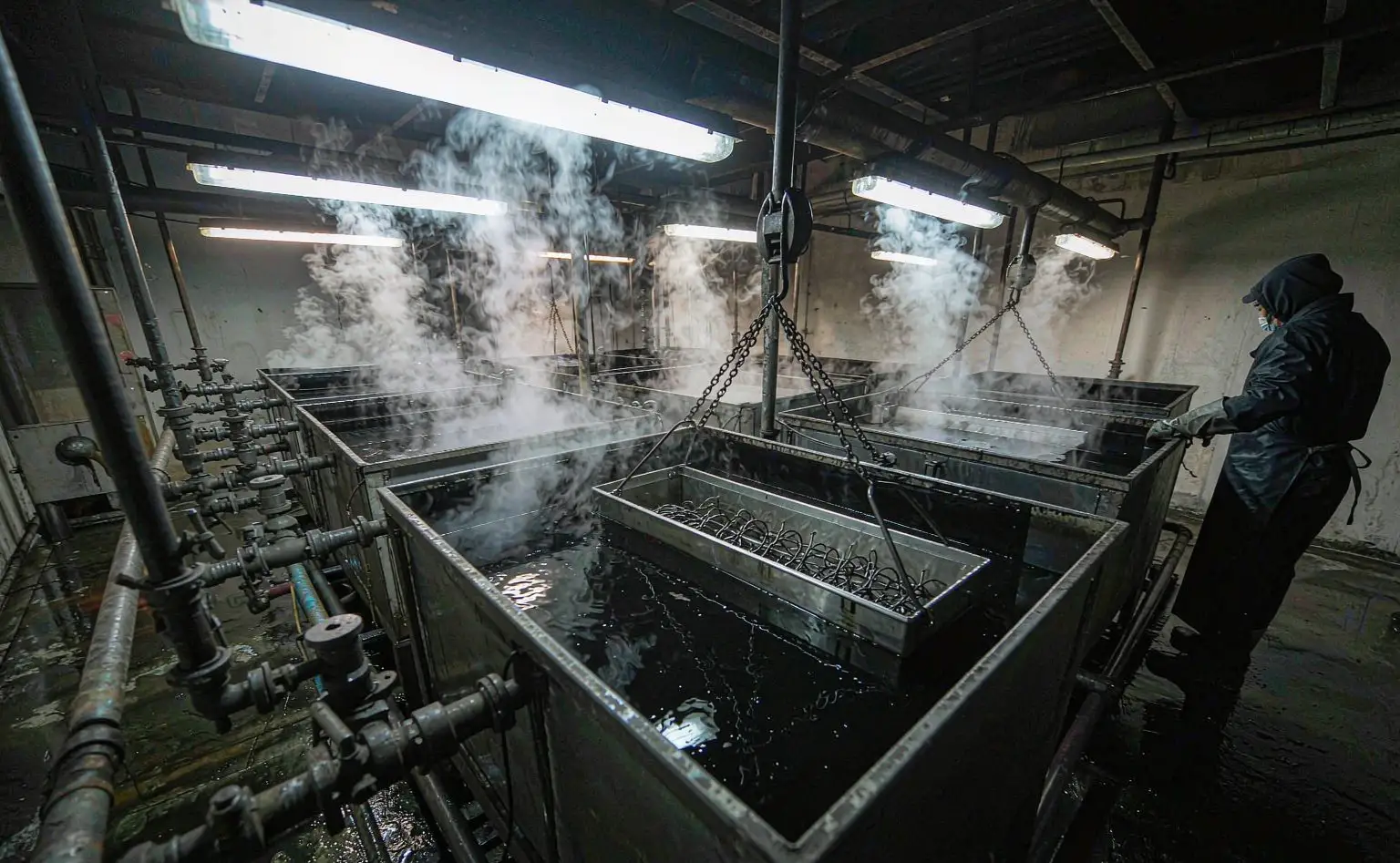
3. Where the sheet goes: between layers, off the wire, count by bundle height
Springs stack tight, so a sheet in the corner does nothing.
Between the layers, not in a corner. Lay a sheet flat between every two or three layers, face down and unfolded, so the vapour travels down. A sheet only on the lid must pass through the whole bundle and is spent before it arrives.
Count by bundle height. One under 100 mm, two for 100-200 mm, three above 200 mm, each carrying 0.1-0.2 g. Stacked sheets lose evaporating surface.
Keep paper between sheet and wire. Vapour-phase paper can corrode poor-quality metal in damp, so never lay the sheet on the wire; put neutral paper or board between them. On thin phosphate or zinc-aluminium coatings, run a seven-day bag test at three times the dose.
Do not strap the bundle dead tight. A strap that leaves room for two fingers is right; strapped hard, there is no air path for the vapour to enter.
| Part / stage | Condition | Product and level | Stage | Control point |
|---|---|---|---|---|
| Film pores | Liquor from the bath | No additive, rinse to neutral | Rinsing | Final rinse at pH 6.5-7.5 |
| Wire and coil gaps | Wet | No additive, stepped drying | Drying | 60-100℃ for 20-40 min, cool and recheck |
| Between layers | Every 2-3 layers | iHeir-D 1-3 sheets (0.1-0.2 g each) | Stacking | Flat between layers, neutral paper below |
| Shipper carton | Corrugated board | iHeir-D 1-2 sheets | Packing | Upper inner wall, off the springs |
| Container | 20 ft / 40 ft | T-1000 8-10 / 10-12 sticks | Loading | On the door, off the cargo |
One boundary. The rinse and the oven cover the pores, the sheet covers the air between layers, the stick covers the container air. None of the three stands in for another.
4. Packing and storage: air first, off the wall, humidity held down
The stretch between drying and packing gets squeezed when the line is busy.
Air before packing. Spread the springs on a rack and cool them to room temperature before stacking; packed hot, the moisture moves out and the sheet takes it up at once.
Off the wall and the floor. Keep boxes 20 cm off the wall, 10 cm off the floor, with gaps between stacks; the row on an outside wall condenses first.
Storage humidity. Hold the store below 60% RH and run a dehumidifier above 70%; log both to trace a bad lot.
Reseal at once. Close the box right after sampling; an open box spends the sheet early.
5. Container and export: sheets in the box, sticks in the container
Export is the last stage that still counts.
Board and lining. Test incoming boards and dry or swap anything above 20%; line the case and put board under the springs.
Sheets per box. Where the layers carry sheets, add one under the lid; two to four for a large case.
Sticks in the container. Hang 8-10 T-1000 sticks in a 20 ft and 10-12 in a 40 ft, on the rings inside the door, staggered. The stick uses a plant-fibre carrier, contains no chloride and is pH neutral, so it does not attack the springs or their film; a salt-type desiccant releases chloride as it takes water up. Comparable practice is in bearing rust oil and drying rods and valve rubber parts and cartoning.
6. Questions from the line
Q: The springs already show white bloom, can they be saved?
A: The bloom is usually alkali. Wash in warm water with a little neutral detergent, rinse and dry again, then look for rust; break up any mouldy bundle and air it.
Q: With a vapour-phase sheet, is a desiccant still needed?
A: It depends where. The sheet covers the box and the stick covers the container; a sheet alone cannot cover hundreds of boxes.
Q: Do blackened and phosphated springs take the same sheet count?
A: The count follows bundle height, not the film. Phosphate and zinc-aluminium films are thinner, so bag-test them at three times the dose first.
Q: Can the oven run at 120℃ to keep up with output?
A: Not advised. The outside skins over, the vapour stays in the pores, and the spring is damp once it cools; use a longer oven instead.
Rinse out of the bath until the final water sits at pH 6.5-7.5, dry from 60-70℃ up to 90-100℃ over 20-40 minutes and cool before stacking; lay one iHeir-D sheet between every two or three layers at 0.1-0.2 g each with neutral paper under it, one for a bundle under 100 mm, two for 100-200 mm and three above 200 mm; add one under the lid and two to four in a large case, bag-testing thin coatings at three times the dose; hang 8-10 T-1000 sticks in a 20 ft and 10-12 in a 40 ft, and keep the store below 60% RH. Mould resistance can be verified to ASTM G21 and GB/T 1741, and lead times are on the iHeir-D product page.


