




 View Count:26
 Date:2026-09-11
Chenghai Toy Export Anti-Mold: Masterbatch & Shipping Protection
Chenghai in Shantou is the largest toy manufacturing cluster in the world — plastic building blocks, RC cars, electronic toys and plush dolls ship from here to retail chains and toy brands across Europe, America, Southeast Asia and South America. Toys are a category of their own: the end users are children, so buyers audit everything against an “in-mouth” standard. When inspectors walk the factory, the question is no longer “will it mold?” but “is the antibacterial treatment food-contact grade? Any migration risk? Can you provide EN71 reports?” Fail to answer and the order goes to a competitor. This article covers the three product lines — plastic, electronic and plush — plus how to prepare the test reports and configure sea-freight moisture protection so the inspection passes on the first attempt.
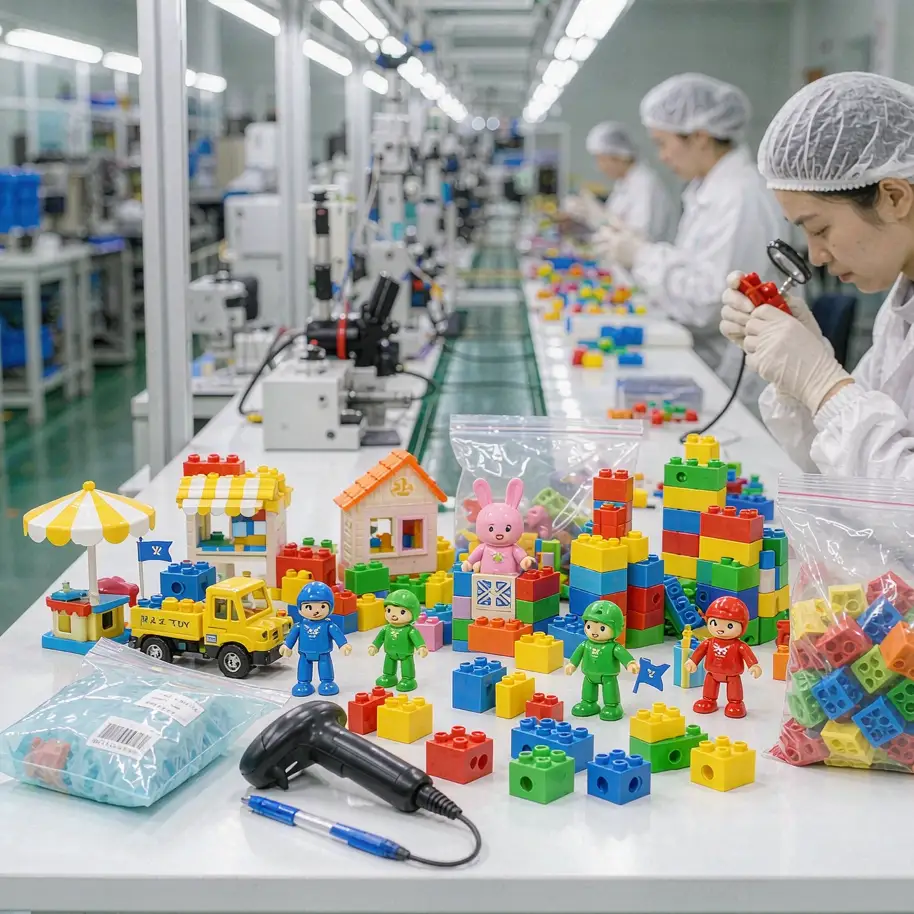
1. Do Toys Really Mold? The Bigger Risk Is Microbial Counts
Plastic itself is not a nutrient for fungus — but a toy is an assembly of materials, and several of them mold readily:
- Surface films: release-agent residue from injection molding, workshop dust and fingerprint oils form an organic film on plastic parts; in humid conditions this film becomes a culture dish. That is why used toys grow surface mold spots;
- Plush and textile parts: plush fabric and stuffing cotton absorb over 10% of their weight in moisture. Two weeks of rainy-season warehouse storage is enough for visible mold and musty odor;
- Paper packaging: color boxes and instruction sheets are pure carbon for fungus. Once container condensation wets them, mold appears in 7–10 days — “the box smelled moldy when the customer opened it” complaints almost always trace back to packaging;
- Hidden microbial counts: more common than visible mold is failing the third-party audit for total bacterial / yeast & mold counts (per GB 15979 or the buyer’s internal standard). A rejected batch means return or destruction on site — a loss far bigger than the goods themselves.
So “anti-mold & antibacterial” for a Chenghai toy factory means three separate tasks: inhibiting microbes in plastic parts, treating textile components, and keeping packaging and transit dry. Miss any one of the three and inspection can stall.
2. Plastic Toys: Solve It at the Source with Food-Grade Masterbatch (ABS/PP)
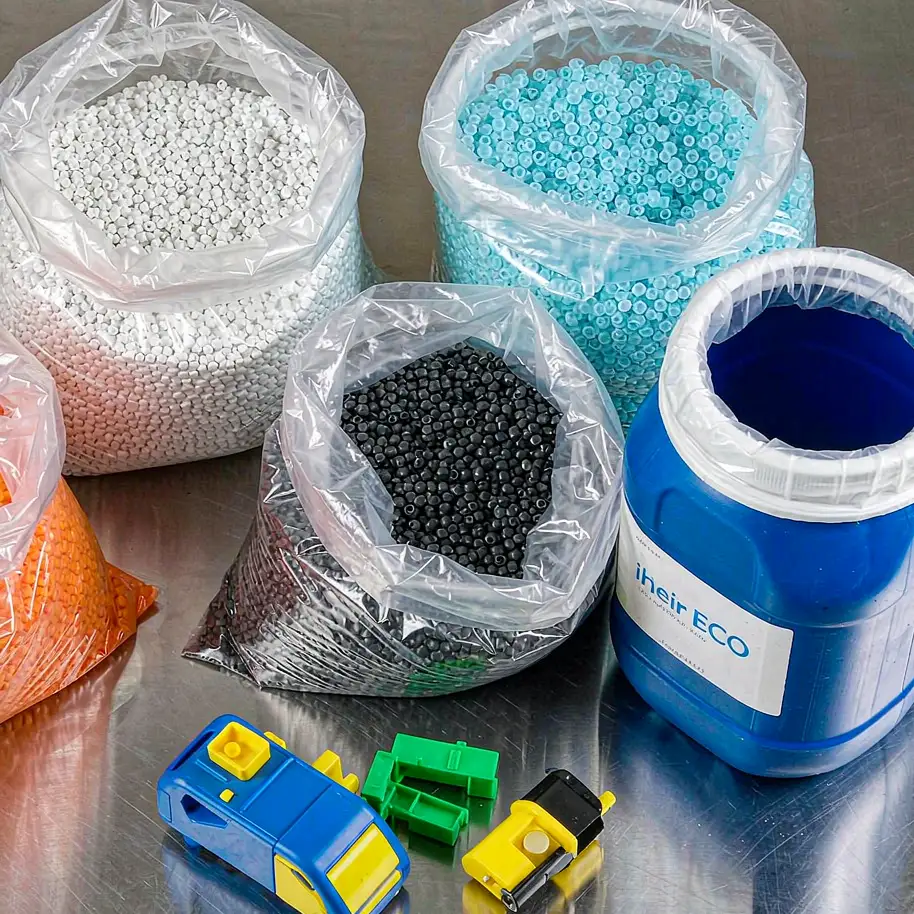
The right way to make plastic toys antibacterial is the masterbatch route: the active agent is compounded into a masterbatch, then dosed into the raw resin during injection molding so it distributes uniformly inside the part — not sprayed onto the finished surface. For toys the difference is decisive:
- Masterbatch (inside the material): no migration, no wash-off, unchanged surface feel, no ingestion risk — the easiest route to pass buyer audits;
- Surface coating: coatings chip under biting and abrasion, creating an ingestion risk. European and American buyers are extremely sensitive to chemical surface treatments on toys — avoid this route entirely.
Select in two tiers:
- Standard toys (blocks, car models, construction sets): compound iHeir-ECO plastic antimicrobial agent into masterbatch at 1%–2% with ABS or PP. iHeir-ECO works across PP, PE, PU and PMMA; against E. coli and Staphylococcus aureus it delivers ≥99% reduction (ISO 22196), lasting the life of the product;
- Food-contact / infant items (rattle parts, teether components, play-kitchen dishes): use iHeir-PSE organic biguanide antimicrobial agent, designed for maternal/infant products, tableware and food-contact scenarios, with documentation support for GB 4806 and FDA/LFGB-style reviews.
Process notes: standard injection parameters apply (ABS 220–250°C, PP 200–230°C) — no mold or process changes. Run a 500–1,000-piece pilot, verify reduction rate and color difference, then scale up. For a deeper comparison of raw-material selection and food-grade options, see food-grade plastic antimicrobial agents explained.
3. Electronic Toys: Keep PCBs and Contacts Dry
For RC cars, electronic plush and sound-and-light toys, the dominant transit risk is not mold but PCB corrosion and battery-contact oxidation — 45 days at sea is enough to whiten solder joints and spring contacts, and a unit that fails to power on is a straight return. Three protections:
- Conformal coating: spray PCBs with polyurethane or acrylic conformal coating before assembly — standard electronics practice against moisture and salt fog;
- Per-box drying: place one 2–5 g silica or CH-10-type anti-mold drying pack inside each color box;
- Battery isolation: where regulations require batteries packed separately, add a small moisture-blocking foam pad in the battery compartment to protect contacts in transit.
4. Plush Toys: Safe Fabric Antibacterial Finishing
For plush dolls, the fabric and stuffing are the mold vectors. The compliant approach is exhaust/padding fixation during dyeing or upon fabric arrival:
- Prepare a finishing bath at 1.5%–2% owf, pad at room temperature (about 70% pick-up), dry at 80–100°C for 2–3 minutes;
- Choose a non-leaching, bound-type textile antimicrobial that chemically bonds to the fiber — critical for toys, because leaching-type agents carry skin-contact and ingestion risk and will not pass EN71 or buyer review;
- Source pre-treated PP stuffing, or spray food-contact-grade solution (diluted iHeir-PSE) at carding and dry before filling;
- Send finished fabric for GB/T 24253 (or AATCC 100) reduction testing and archive the report for buyer audits.
Wooden components (gears, wooden accessories) need a completely different, wood-specific treatment — see the wooden toy export anti-mold guide; mixed plastic-plus-wood orders should be processed separately.
5. Warehousing and Sea Freight Configuration
The finished-goods warehouse and the container decide the on-arrival condition:
- Warehouse: red line ≤65% RH; color-boxed goods on pallets 15 cm off the floor, 30 cm off walls, with ventilation lanes between stacks; run dehumidifiers through the rainy season;
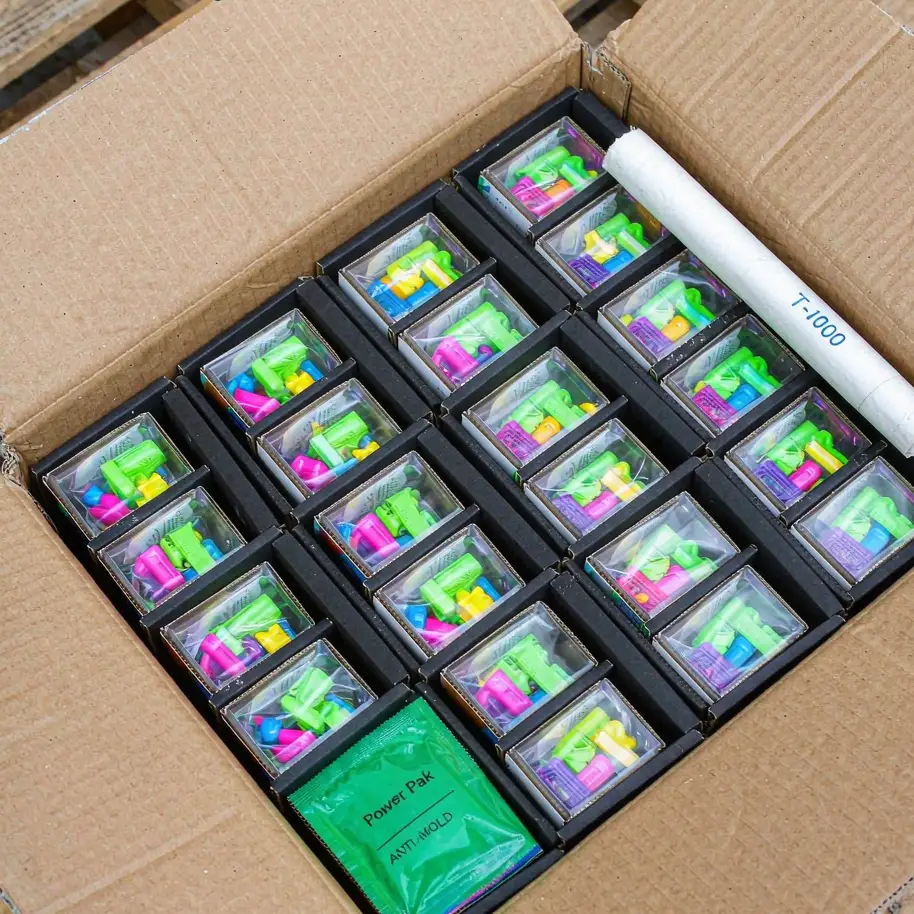
- Carton protection: 1–2 Power Pak anti-mold & deodorizing tablets per export carton — mustard-extract slow-release renders the carton fungus-free within 72 hours of sealing, with no corrosion or discoloration on printing, plastic or hardware, and DMF-free per EU REACH;
- Container drying: 6 T-1000 container desiccant sticks per 20-ft container (10–12 per 40-ft) to fight “container rain” — toys are exactly the carton-plus-color-box cargo most sensitive to internal condensation, so never skip this;
- Loading window: load on dry mornings and close doors immediately; avoid opening containers at night when humidity peaks.
6. EN71 / ASTM F963 / GB 6675 Reports + FAQ
A complete report chain is the pass for factory audits and shipment inspections. Keep these ready:
- Toy safety: EN71-1/2/3 (EU mechanical, flammability, heavy-metal migration), ASTM F963 (US), GB 6675 (China) — sent as full-together samples;
- Antimicrobial performance: plastic parts per ISO 22196, plush fabric per GB/T 24253 or AATCC 100, with the report noting “active agent incorporated in the material, not a surface coating”;
- Compliance declarations: obtain REACH/ROHS conformity and DMF-free statements from the antimicrobial supplier to hand over with the reports;
- Claim labeling: if the product says “antibacterial”, EU BPR rules apply — confirm the active ingredient is on the BPR approved list and keep the supplier’s supporting file.
Case study: In 2024, a mid-size Chenghai toy factory shipped 68,000 plastic construction sets to Chile. The buyer’s SGS sampling found total microbial counts three times over the limit; the batch was rejected and returned, costing about RMB 470,000 including port charges. Root causes: the flocked mini-figure included in each set had no antimicrobial treatment, and the 38-day voyage ran without container desiccant. After rectification — flocked parts switched to bound-type textile treatment, one Power Pak per carton, 6 T-1000 sticks per container, and all plastic parts switched to iHeir-ECO masterbatch with ISO 22196 reports — the same buyer re-ordered three times with passing audits each time.
FAQ:
Q1: Do plastic toys really need antibacterial treatment, or is it over-marketing?
A: Depends on the channel. Since the pandemic, Western retail chains and maternal-infant channels increasingly list antibacterial as a scoring or hard criterion; suppliers with ISO 22196 reports get measurably better pricing power. Masterbatch adds only about RMB 0.05–0.15 per unit — a low-cost compliance investment. For low-price domestic-only channels, follow the customer’s requirement.
Q2: Will masterbatch discolor toys or add odor?
A: iHeir-ECO/PSE carrier resins match the base resin; at 1%–2% there is no visible color shift on light-colored parts and no odor. For transparent parts, run a pilot to check haze first.
Q3: What does “food-contact grade” actually mean here?
A: Separate two cases: mouthable parts (teether, rattle mouth) use food-contact solutions like iHeir-PSE with GB 4806/FDA-style documentation; non-mouthable parts (shell, wheels) can use standard iHeir-ECO. Define part attribution in the contract to avoid pricing the whole container at the strictest standard.
Q4: Does the EN71 report cover antimicrobial testing?
A: No. EN71-1/2/3 covers mechanical, flammability and heavy-metal migration only. Antimicrobial performance is a separate ISO 22196 (plastic) or GB/T 24253 (textile) report — the two run in parallel.
Q5: Plush toys arrived with a musty smell. What now?
A: Light odor only: bake at 60°C for 40 minutes, cool, then rest 48 hours in a bag with a Power Pak tablet. Visible mold: scrap and remake the fabric — washing removes the spot but spores remain and it will recur. Immediately audit same-warehouse stock; mold never strikes alone.
Want to pass buyer audits and microbial sampling in one go? Contact us for samples and a tailored plan. iHeir-ECO plastic antimicrobial agent, iHeir-PSE food-contact-grade antimicrobial and Power Pak tablets are in stock. For the general export-toy compliance framework, also read export toy anti-mold & EN71 compliance.