




 View Count:40
 Date:2026-09-05
“My wooden toys got moldy — what now?” Yunhe County in Zhejiang is China’s wooden-toy cluster, exporting blocks, puzzles, xylophones and educational toys to Europe, the US and Japan by the container load. Wooden toys are different from other wood products: you must control mold and pass toy-safety regulations at the same time. Get it wrong and you face either moldy returns or failed lab tests. This guide follows a real Yunhe factory’s process line — material selection → blanks → anti-mold treatment → finishing → export — and explains the moisture and mold risk at every gate.
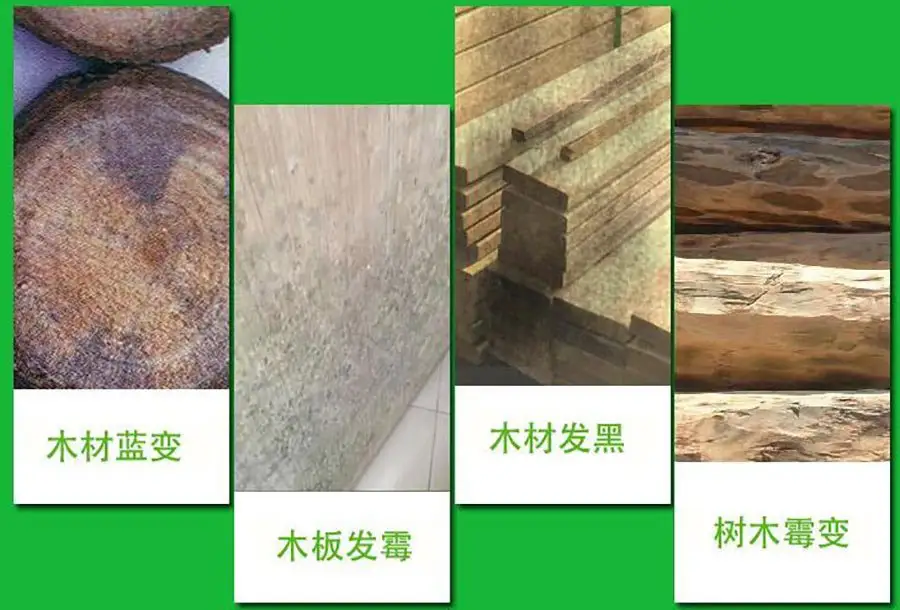
1 Why do wooden toys mold? Three root sources
The problem is usually not “the toy” but “the wood” and “the workshop.” Find the source and prevention becomes straightforward:
- Source 1: wood moisture content too high. Wood is a natural material — excess moisture feeds mold. Factories that use poorly dried blanks or import wet lumber can have core moisture above 15%; the parts “sweat” later and mold by the time they reach the customer.
- Source 2: damp blank warehouse and workshop. Raw blanks (unfinished wood parts) have a large surface area and absorb moisture easily. Stacked in a humid semi-open workshop, they can dampen in two or three days during the wet season. Glue, wax and water-based paint dry slowly in humidity, extending the high-risk window.
- Source 3: container condensation at sea. Export toys spend 20-40 days at sea; container walls sweat at night (“container rain”) and wet the outer cartons first, then moisture migrates through to the toys.
Keep one fact in mind: at 20-35°C and above 70%RH, mold can grow on wood surfaces within days. So prevention is not about cleaning mold after it appears — it is about controlling moisture content and workshop humidity at the source.
2 Material gate: why wood moisture must stay at or below 12%
Wooden toys demand tighter moisture control than ordinary furniture. Mature exporters hold incoming wood at ≤12% moisture, and factories making precision interlocking parts often target 8%-10% to prevent warping and cracking.
| Process point | Moisture target | Risk if not met |
| Lumber receiving | ≤12% (batch spot checks with a moisture meter) | Core moisture enters the workshop and is hard to fix later |
| Blanks after cutting/sanding | 10%-12% | Semi-finished parts absorb moisture and mold within days |
| Before finishing | Balanced with environment (8%-12%) | Moisture trapped under water-based paint grows mold under the film |
A pin-type moisture meter is the cheapest “mold-prevention equipment” a toy factory can buy — check at receiving, cutting and before finishing. The full logic of wood moisture and anti-mold treatment is explained in our how to use wood anti-mold agents guide.
3 Blank gate: controlling the blank warehouse
Raw blanks are the weakest link — large surface area, open pores, no coating protection. Three practical actions for toy factories:
- Keep the blank warehouse separate and controlled. Do not store blanks with the paint shop or damp raw materials. Keep relative humidity below 60%-65%RH with a dehumidifier; stack blanks 20cm+ off the floor and away from walls, leaving air channels between pallets.
- Do not let semi-finished parts pile up overnight. Sanded blanks should move into finishing the same day when possible. If temporary storage is unavoidable, cover with breathable non-woven fabric or open-slot cartons — never seal in plastic bags, which trap moisture and speed up mold.
- Increase spot checks in the wet season. Clean the blank warehouse before the rainy season, then open and feel cartons weekly: a chalky surface or a change from “wood-dust smell” to an earthy smell means action needed — pull and quarantine those parts.
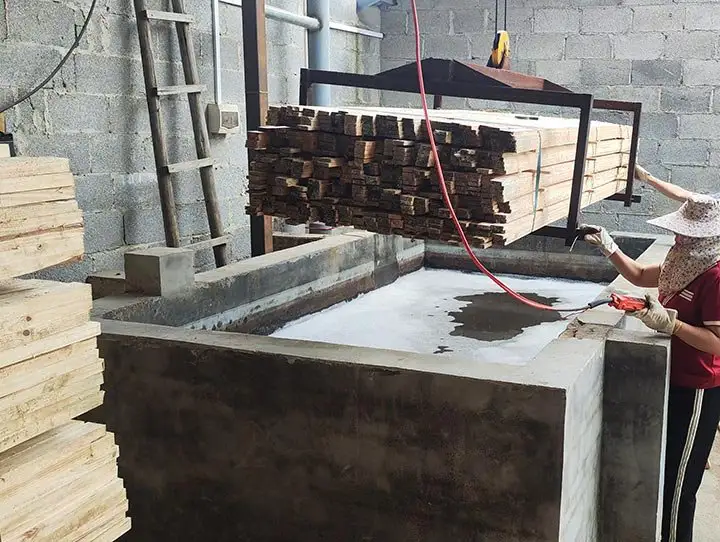
4 Treatment gate: effective anti-mold that stays toy-safe
Whether, how and on what to apply anti-mold treatment is where many factories hesitate. The answer: yes it can be done — but separate “which part, which stage, which agent,” and follow toy-safety logic.
① What needs treatment? Blanks and semi-finished parts (puzzle boards, block parts, xylophone bars) suit anti-mold treatment. Parts that contact a child’s mouth directly, or custom parts with strict food-contact requirements, must not use agents that have not been specifically safety-assessed — follow customer requirements and target-market regulations.
② At what stage? The best window is after sanding, before finishing: the wood surface is clean and absorbent, so the active ingredient enters the surface layer. Applying after water-based paint is far less effective.
③ Which method? Two mainstream processes:
- Soaking — ideal for regular-shaped parts in volume. Mix iHeir-MA soaking-type bamboo-wood preservative per the label ratio, soak blanks for 15-30 minutes, drain and dry back to target moisture before the next step. Soaking reaches internal gaps and gives the most even coverage, but needs drying racks or a drying room.
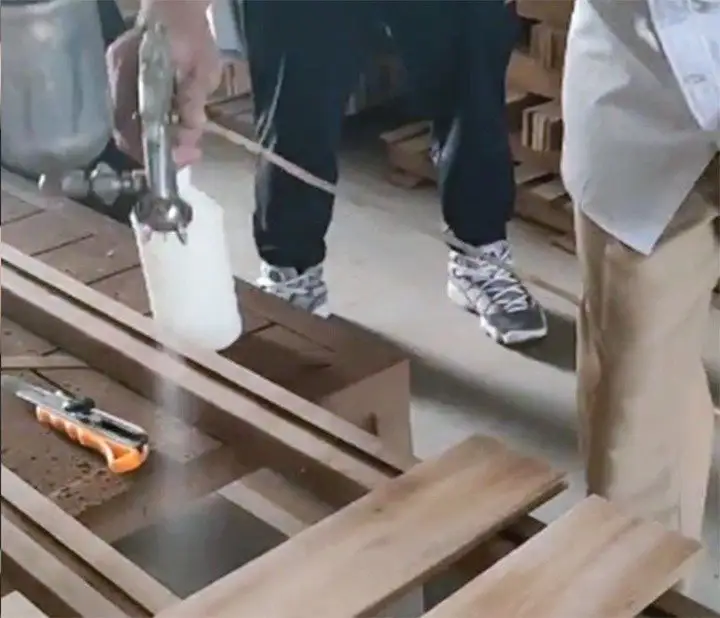
- Spraying — suited to irregular parts, assembled semi-finished goods or small trial batches. Spray iHeir-Spray (M3D) water-based anti-mold agent evenly and let it film dry. Spraying is flexible but covers deep grooves and blind holes poorly — combine soaking and spraying for important export items.
④ Is it compatible with water-based paint? After treatment, before painting, always run a small compatibility test: treat half of a batch and leave half untreated, paint both, and observe for 7-14 days to confirm no blistering, cracking, blooming or adhesion loss before going to volume. Residual agent on the surface can affect paint adhesion, so dry and sand per the process spec after treatment.
On toy safety: wooden toys exported to the EU must meet the EN71 series (EN71-3 for migration of heavy metals, EN71-9 for organic compounds); the US market adds CPSIA. Whether an agent or process affects test results depends on its composition and residues — run a screening test at an accredited lab for the target market before scaling. For the full export-testing and moldy-return picture, see our export toy anti-mold & EN71 compliance guide.
5 Export gate: the last three kilometers
The worst outcome for wooden-toy exporters is “moldy on arrival” — it means returns, claims and lost customers. Manage the last stretch and rework rates drop sharply:
- Recheck moisture before packing: spot-check finished goods (target ≤12%) before cartoning; during the wet season let finished goods “settle” in a dry room before packing.
- In-carton desiccant must be compliant: if an overseas customer asks for desiccant inside the carton, use food-contact-compliant barrier packaging and get written approval. Toys are children’s products, so in-carton accessories must also be child-safe.
- Container moisture control: inspect the container before loading (dry, leak-free, odor-free), and hang T-1000 container desiccant sticks — 6-8 for a 20-ft container, 12-16 for a 40-ft unit, choosing the upper range on humid routes. Dosing logic is in our container desiccant dosage guide.
- Keep records: retain moisture-check records and treatment process sheets for every batch so complaints can be traced to the exact step.
A real example (name withheld): a Yunhe factory exporting building blocks hit continuous rain one May. A dehumidifier failure in the blank warehouse went unnoticed, and a batch of sanded blanks sat for 10 days — some surfaces grew fine white fuzz. Instead of scrapping, the factory re-dried the blanks, sanded off the surface mold, re-treated them by soaking, replaced the dehumidifier with an alarm model, and cut blank turnaround from 7 days to 3. Through the rest of that wet season, the line saw no further mold complaints.
Wooden instruments and panel products follow similar logic — see wooden instrument export mold prevention.
6 Wooden toy FAQ
Q1: A blank has light mold — can I sand it off and reuse it? If the mold is only on the surface, the wood is not softened and the color is normal, sanding the mold layer away and re-treating by soaking is acceptable. Blanks that are dark, soft or strongly musty should not re-enter production — one contaminated part can taint a whole batch.
Q2: Will anti-mold treatment make the toy fail EN71? Not necessarily. What matters is whether the agent contains restricted substances and whether surface residues comply — not “whether treatment was done.” Choose agents free of restricted substances, keep residues within spec, follow target-market rules, and screen-test at a third-party lab first.
Q3: Can painted (water-based) toys still get mold protection? Yes, but the anti-mold treatment belongs before finishing (blank/sanded stage). Finished goods can only be protected physically during packing and shipping — control humidity, use desiccants and container drying sticks. Nothing can be “added” to finished coated products.
Q4: What should a toy factory do first in the wet season? Put thermo-hygrometers (readable to 1% RH) in the blank and finished-goods warehouses, log readings, and hold humidity below 65%RH; then fix blank turnaround time. Until humidity is under control, anti-mold agents alone will be cancelled out by the environment.
Q5: Extra precautions for the US market? Besides CPSIA, watch California Proposition 65 and state-level rules. Whether preservative/anti-mold components must be declared or appear on restricted lists must be checked against the MSDS and target-state regulations, with help from a compliance consultant when needed.
Wooden-toy mold prevention is a system: moisture content, the blank warehouse, treatment process and container protection — close every gate and exports go smoothly. If your factory is fighting wet-season dampness, moldy blanks or sea-freight mold, contact us — tell us your material, process and target market. We talk process first, products second, and validate with samples and data.