




 View Count:25
 Date:2026-09-11
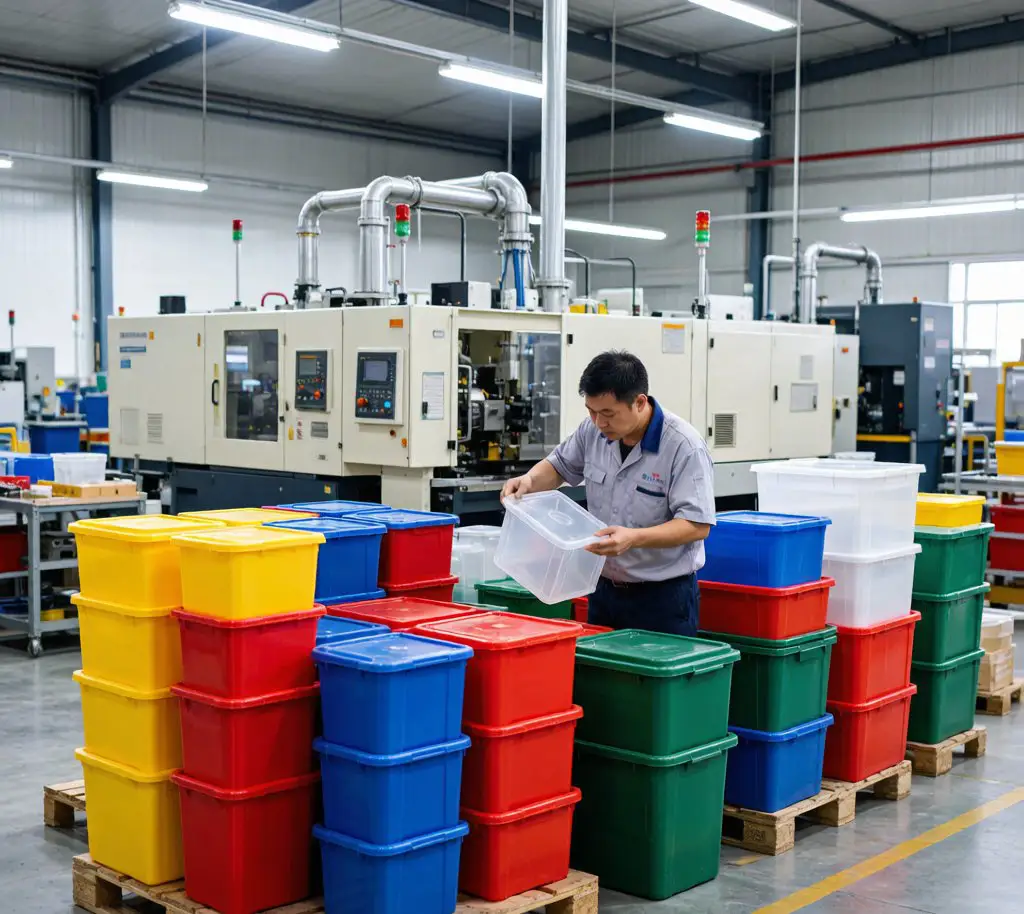
Huangyan, Taizhou — China’s injection-molding capital — turns out millions of plastic storage boxes, trash bins, hangers and cleaning brushes every month. Yet every rainy season, quality managers face the same complaint: white-grey mold spots appear on box corners after three days in the warehouse, or worse, a US buyer’s inspection finds fungal growth on product surfaces and rejects the whole container. The saying “plastic doesn’t mold” is only half true: the polymer itself isn’t food for fungus, but everything sitting on its surface is. This guide walks Taizhou housewares factories through the full control chain — masterbatch, surface spray, warehouse and container — so mold and odor complaints stop for good.
1. Why Plastic Molds: Surface Films and Crevices Feed Fungus
Mold cannot grow on clean PP or HDPE because there is no carbon source. But an injection-molded part leaving the press is never clean. Four things coat it: mold-release residue (silicone oils and stearates — themselves a carbon source), fingerprints and skin oils from assembly and packing, dust and organic deposits picked up in storage, and additive bloom — talc and slip agents migrating to the surface. That is why mold strikes first where nobody wipes: inside box corners, trash-bin lid hinges, hanger hook bends. Once relative humidity crosses 75%, visible colonies form within 24-48 hours.
Meanwhile the EU BPR and buyer factory audits have turned “antibacterial” from a bonus into a market-entry requirement. For Taizhou exporters, antimicrobial treatment is now an order-qualification issue, not just a quality issue. Our overview of plastic antimicrobial agent types covers the basics; this article focuses on factory-floor execution.
2. Choosing a PP/HDPE Antimicrobial Masterbatch: Four Parameters
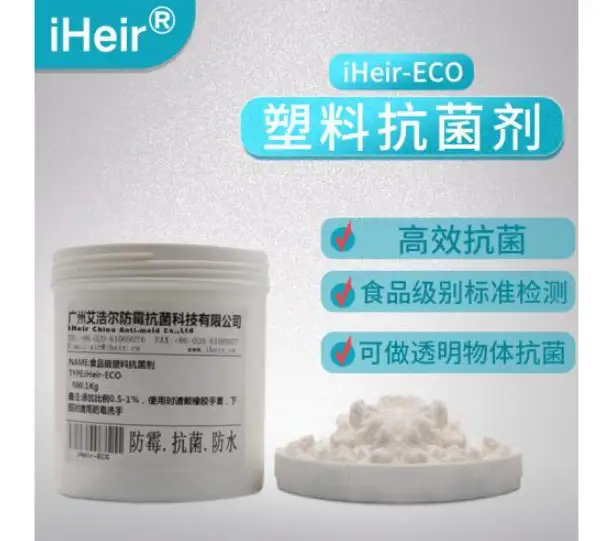
Compounding the antimicrobial into the resin is the simplest route — one addition, lifetime protection, no line modification. Take iHeir-ECO plastic antimicrobial agent as the reference: check four parameters before you buy any masterbatch.
1) Active ingredient and heat stability. Processing runs at 180-240 °C; silver-ion inorganic agents such as iHeir-ECO and iHeir-IPI decompose above 500 °C, so they survive. Organic agents must have a decomposition margin of at least 30 °C above your barrel temperature. 2) Food-contact compliance. Storage boxes and food containers need GB 4806.7 / FDA 21 CFR clearance — iHeir-ECO is tested to food-grade standards at 0.5-1% loading. 3) Spectrum. E. coli and S. aureus are baseline; trash bins should also pass the 28-day fungal test (GB/T 2423, growth rating 0). 4) Effect on clarity. Standard silver ions can tint high-clarity PP; transparent articles should use a dedicated clear-grade such as iHeir-IPL.
Do a gradient trial before locking the formula: run coupons at 0.5%, 1%, 2% loading and quantify with ISO 22196. Below 0.5% the effect decays fast; above 3% you are burning money and risking mechanical properties.
3. Surface Spray: When It Beats Masterbatch
Three situations favor spraying. Rush orders — a masterbatch needs 2-4 weeks from trial to stable production; a spray line tunes in 3-5 days. Surface-only requirements — bin exteriors or hanger bars can be treated alone, halving chemical use. High recycled content — regrind carries more contaminants that dilute a masterbatch, so a surface layer tops up protection.
Use iHeir-Spray water-based anti-mildew agent diluted 1:10-1:20, applied evenly at 20-40 m² per kg of solution. Three rules: degrease first (wipe with iHeir-Clean — leaving the film on is feeding the fungus); dry at 40-60 °C for 10-15 minutes to form the coating; do not over-apply — a thick film turns tacky, collects dust and becomes a new contamination source. Verify with GB/T 31402; the pass line is ≥90% reduction. Masterbatch and spray are complements, not alternatives — high-end export programs often run both.
4. Warehouse Discipline: Stacking, Pallets and the 75% Line
Taizhou’s June-July plum-rain season pushes warehouse humidity above 85%. Even a compliant masterbatch will not save you if storage is sloppy, because mold grows on surface dust regardless of your test report. Four red lines: stack cartons no higher than 1.8 m with ventilation gaps between layers; keep pallets 15 cm off the floor and 30 cm from walls — ground moisture on ground-floor warehouses is an invisible water source; monitor with 2-3 hygrometers and start dehumidifiers (from 90 L/day per 150 m²) whenever RH exceeds 75% — a few dollars of electricity a day beats a USD 5,000-10,000 container claim; and wipe product surfaces with lint-free cloth before packing, especially inner corners, so spores land with nothing to eat. Our warehouse moisture-control plan details the layout and equipment sizing.
5. Ocean Freight: Treat the Container as a Sauna
The 14-18 day trans-Pacific crossing swings 10-15 °C between day and night, cycling water through evaporation and condensation — the classic “container rain”. Plastic parts do not fear water, but cartons, labels and surface dust do. Three safeguards: hang 6-8 T-1000 container desiccant sticks per 40HQ (each absorbs 2-3× its weight in water) on the wall posts; drop 1-2 CH-10 anti-mildew drying and deodorizing packs into each storage-box cavity — essential for trash bins, because a 20-day stewed odor ruins the unboxing experience; and inspect the container before loading, photographing the box number, stick count and positions for the record. Our Cixi appliance export guide shows the same packing logic for electronics.
6. Test Reports, Complaint Handling + FAQ
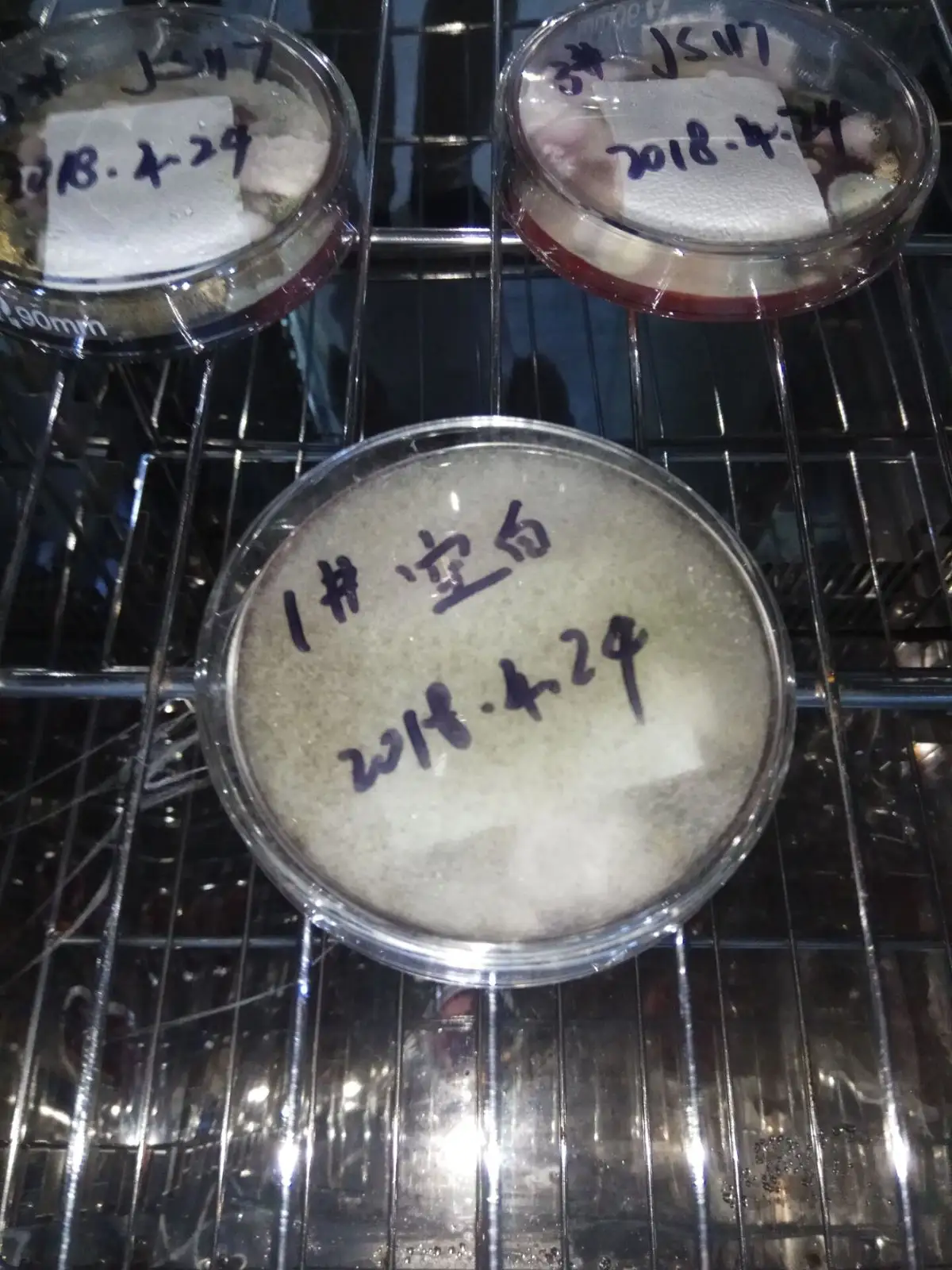
Prepare reports per destination: US buyers expect ISO 22196 (quantitative surface antibacterial) plus ASTM G21 (resistance of plastics to fungi); EU buyers want the efficacy report plus a BPR compliance statement; domestic retail runs on GB/T 31402. Use a CNAS/CMA-accredited lab and keep sample IDs, standards and numeric reductions on the certificate. If a complaint lands, run the three-step protocol: lock the evidence (container number, unboxing photos, mold location); attribute the failure — moldy carton with clean product means container wetting (logistics), localized spots mean surface film plus warehouse humidity (production), whole-shipment mold with odor means no packing protection (SOP gap); then remediate — wipe with iHeir-Clean, re-spray with iHeir-Spray, restock desiccant — and send the corrective-action report with fresh test data. Handled this way, a claim often becomes a re-order.
FAQ
Q1: Will silver-ion masterbatch discolor transparent storage boxes?
A: Standard grades can add a slight grey tone in high-clarity PP. Use a clear-dedicated grade such as iHeir-IPL at 0.8-1.2% and confirm color delta on trial shots first.
Q2: Is antibacterial enough for trash-bin odor?
A: Antimicrobial stops growth; it does not mask existing smell. Combine a masterbatch with a CH-10 deodorizing pack in each bin, and odor complaints drop sharply.
Q3: Do recycled-content products benefit from antimicrobial?
A: Even more than virgin resin — regrind carries higher bioburden. Run masterbatch plus surface spray, and raise loading 0.3-0.5 points versus virgin.
Q4: How long are test reports valid?
A: The certificate itself does not expire, but buyers usually require it to match production within one year. Any formula or resin-supplier change triggers retesting.
Mold control for Taizhou housewares is management across three lines: the right masterbatch once, warehouse humidity held under 75%, and enough desiccant in every container. For masterbatch trials, spray parameters or report templates tailored to your resin and destination market, contact us — we will put a workable plan in your hands.