




 View Count:32
 Date:2026-11-17
How should chain mould be handled? By separating oil from water: an oil-soluble additive goes into the rust oil, every chain is blown and wiped before cartoning, and vapour-phase sheets go into the box. A chain hung in a damp store grows mould under the film first, and rust starts in the spots. The handling is an additive in the oil, a wiped chain, and 0.1-0.2 g iHeir-D gas-phase sheets per carton. This article gives the blend ratio, the wiping criteria and the sheet count.
1. Where chain mould comes from: water under the film, joints, packing, container
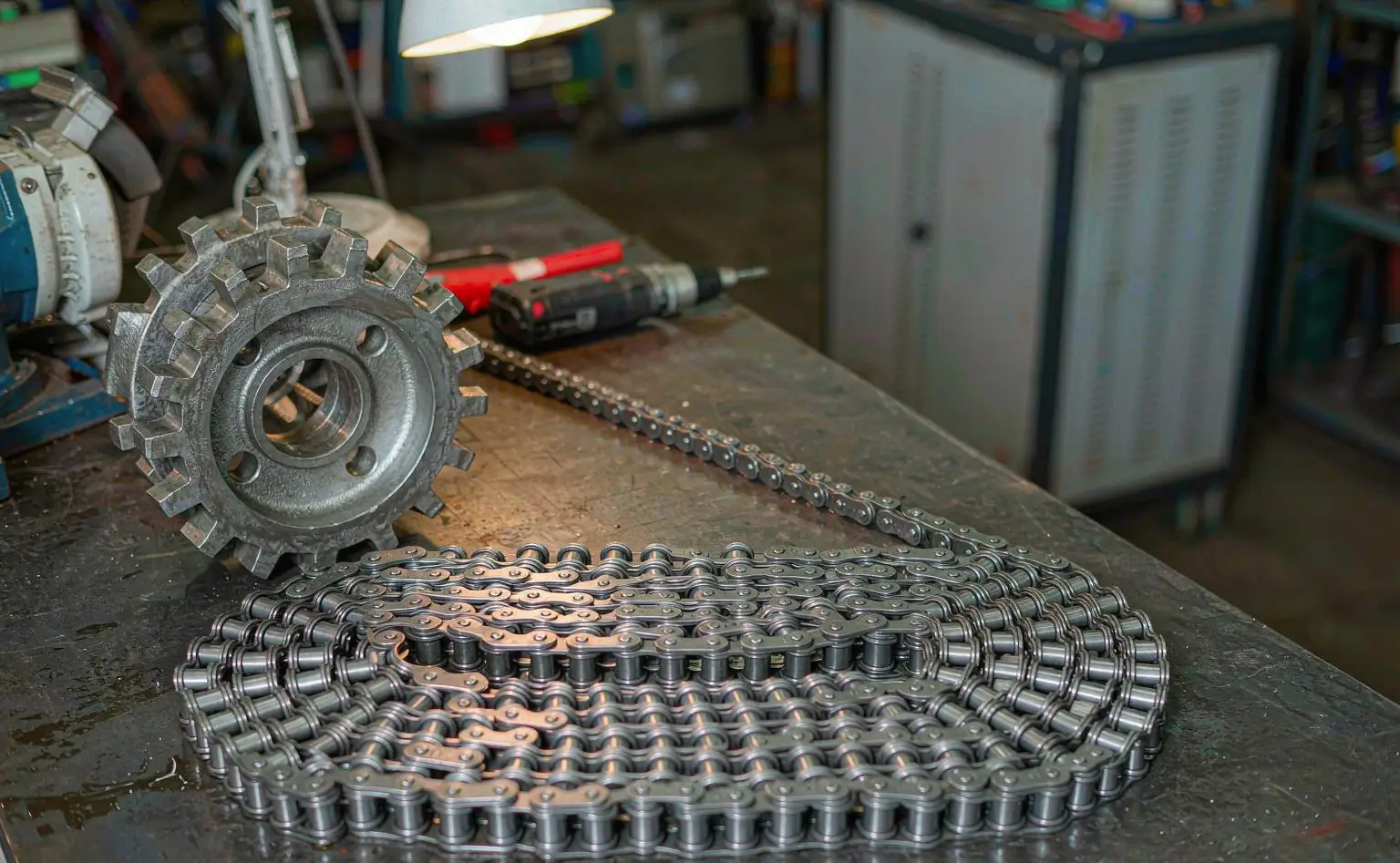
A roller chain is plates, pins, bushes and rollers, cleaned, oiled, run in, inspected and packed. Steel does not grow mould; growth sits on the residue and dust held in the oil film.
Water under the film comes first. Washing water stays in the joints and oil floats on it, sealing it between pin and bush. As the store cools, vapour blisters through the film, and that spot is where mould and rust both start.
Joints and roller bores come second. These cannot be wiped or blown into; they depend on what the oil carries in. A bore holding water rusts faster than an outer plate, and does not show until the chain seizes in service.
Packing and container come third. Cartons, pallets and cases absorb moisture, and in a 20 ft container the water condensing on the walls ends up in the bottom layer. Over 30-45 days at sea, the container swings 15℃.
Each source needs its own answer: film water by drying before oiling and by the additive, the joints by what the oil carries, the packing by sheets and sticks. A chain cannot be cleaned afterwards; it can only be protected.
2. How to dose the oil: an oil-soluble grade, on oil weight, with a settling check
Choose an oil-soluble grade. A water-based agent splits out of a mineral or synthetic oil, throwing floc or dropping water, and a broken film protects worse than none. Take 200 ml of oil, add the agent at the target ratio, stir ten minutes, stand 24 hours and look for separation or haze.
How much. Start low on total oil weight, run seven days before production. Too little never reaches the joints; too much thickens the oil, drains badly and leaves a film that holds water.
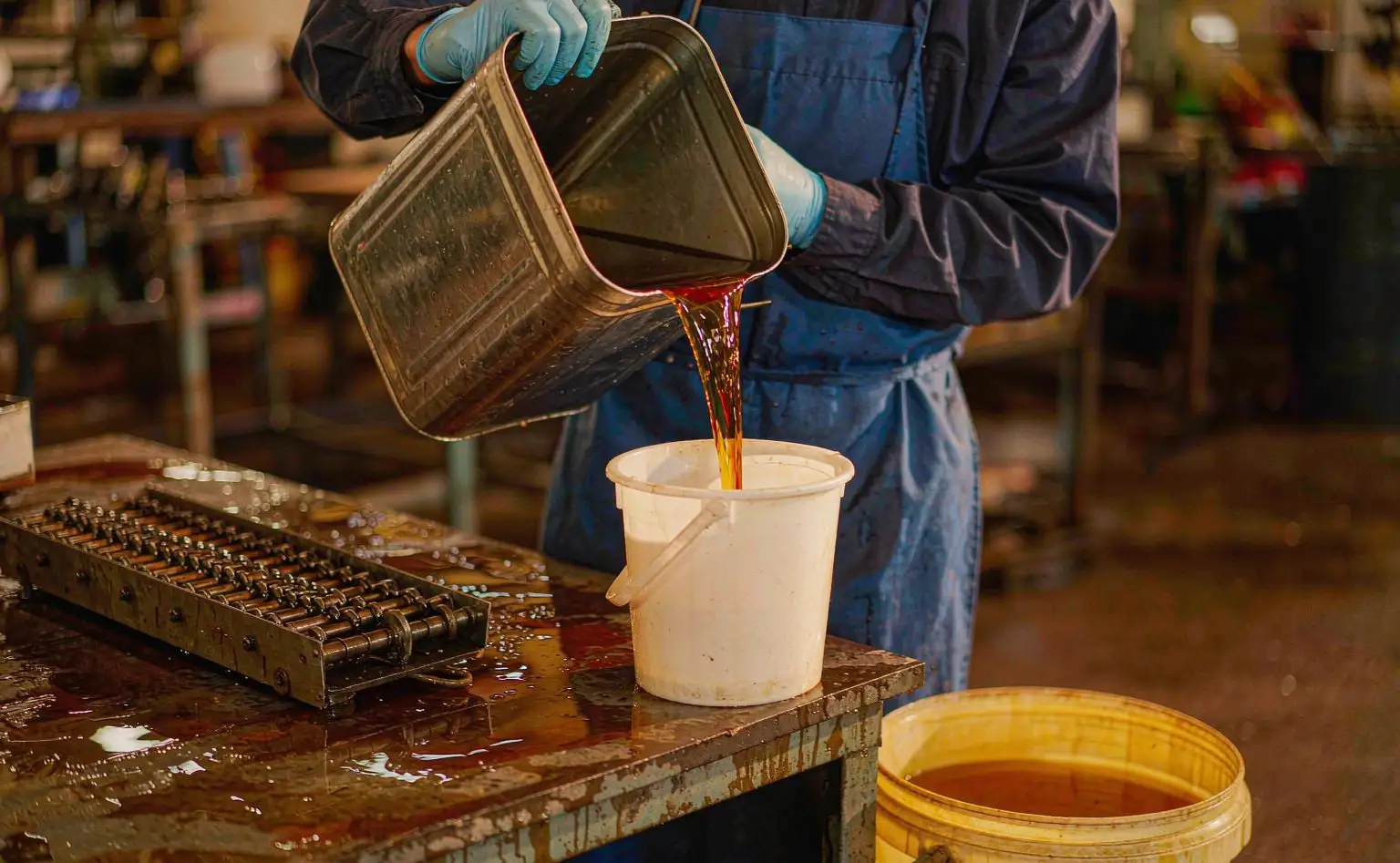
How to blend. Add the agent in a stirred tank at 40-50℃, stir 20-30 minutes so it dissolves. Never tip powder into the dip tank: it cakes on the bottom, plugs nozzles and leaves white specks. Keep a labelled sample of every blend.
How to apply. Dipping beats brushing: two to five minutes in the bath, then ten to fifteen draining. On a continuous line, set the speed from the drain time, or the oil goes into the packing.
3. How to wipe before cartoning: blow, then wipe, one chain at a time
Blow before wiping. After draining, blow dry compressed air through the joints and bores at moderate pressure so the film is not stripped; wiping first only spreads the water.
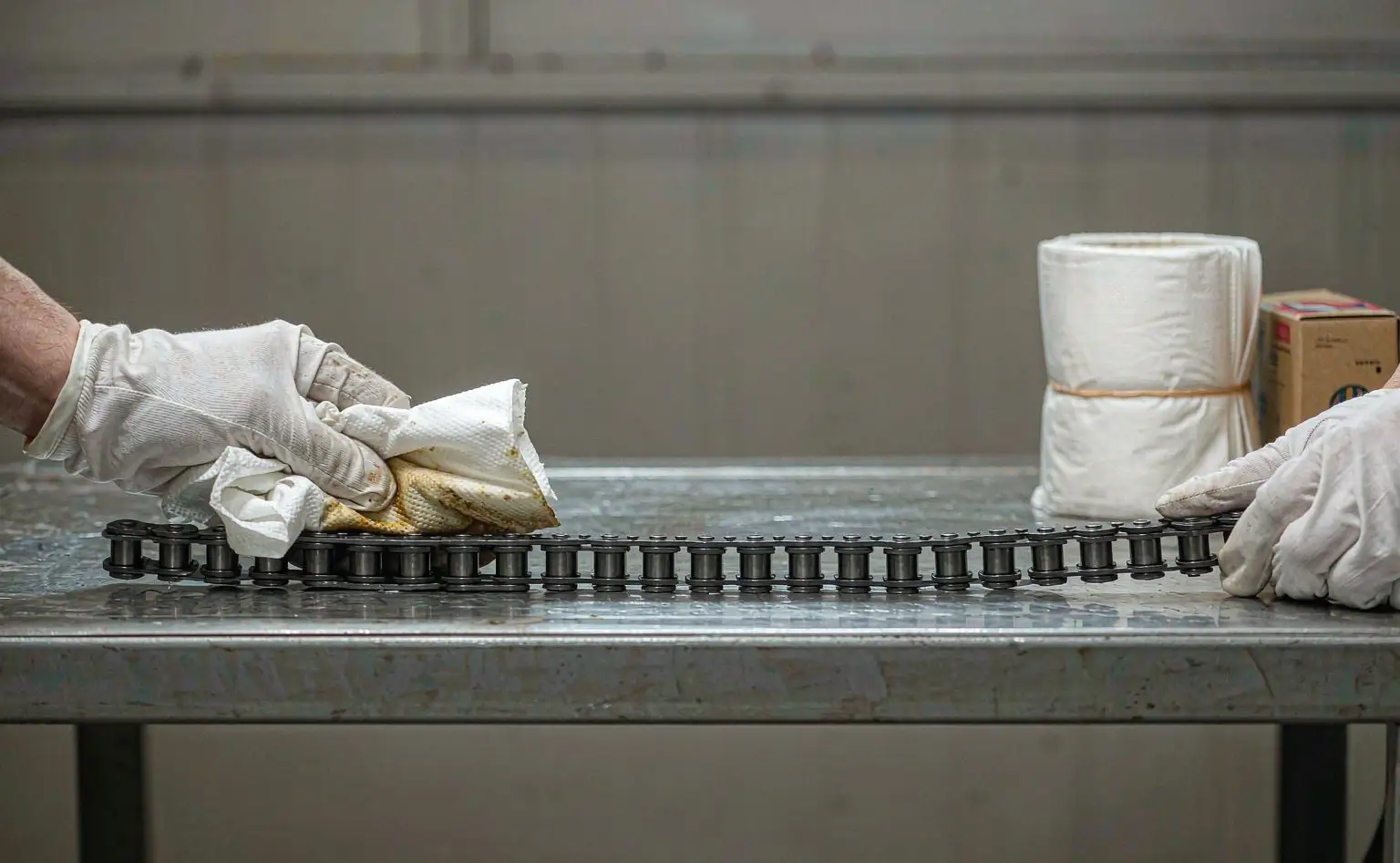
One chain at a time. Wipe the plates and rollers with clean white cotton; change the cloth as soon as it darkens. Let the chain stand 30 minutes so the oil evens out.
The criterion. Read the cloth, not the clock: no water mark and no grey sludge means done; a water mark sends the chain back to the air gun. Neither tacky nor dripping, it is ready for the carton.
Do not force it with hot air. Blowing the oil out leaves the joints quicker to take water up; use dry air at room temperature, below 40℃.
| Part / stage | Condition | Product and level | Stage | Control point |
|---|---|---|---|---|
| Joints and roller bores | Wet after washing | Rust oil with an oil-soluble agent | Blending and dipping | 24-hour sample shows no separation |
| Outer plates and rollers | Oil film | No additive, blown and wiped | Before cartoning | Cloth free of water marks and sludge |
| Shipper carton | Corrugated board | iHeir-D 1-2 sheets (0.1-0.2 g each) | Packing | Upper inner wall, off the chain |
| Export case | Case and pallet | iHeir-D 2-4 sheets | Packing | Board moisture at or below 20% |
| Container | 20 ft / 40 ft | T-1000 8-10 / 10-12 sticks | Loading | On the door, off the cargo |
One boundary. The agent in the oil covers the joints, sheets in the box cover the small volume, sticks in the container cover the air. None of the three stands in for another.
4. Unpacking and storage: reseal at once, stack with gaps
Between arrival and the next dispatch is where much second-hand growth happens.
Reseal after inspection. Close the box straight after sampling; an open box spends the sheet early. Put sampled chains in their own bag.
Stack with gaps. Keep boxes 20 cm off the wall, 10 cm off the floor, with gaps between stacks. The row on an outside wall condenses first.
Store humidity. Hold the store below 60% RH and run a dehumidifier above 70%; log temperature and humidity to trace a bad lot later.
Re-oil. Past three months, or when a box opens to a dry film, give a thin coat, reseal and replace the sheet.
5. Case and container: sheets inside, sticks in the box
Board moisture first. Test incoming boards and dry or swap anything above 20%; line the case with barrier film and put board under the chain.
Sheets per case. One for a carton under 25 kg, two to four for a large case, at 0.1-0.2 g of active each, fixed on the upper walls and clear of the chain. Vapour-phase paper can corrode poor-quality metal in damp, so where galvanising is thin run a seven-day bag test at three times the dose.
Sticks in the container. Hang 8-10 T-1000 sticks in a 20 ft and 10-12 in a 40 ft, on the rings inside the door, staggered. The stick uses a plant-fibre carrier, contains no chloride and is pH neutral, so it does not attack the chain or its plating; a salt-type desiccant releases chloride as it takes water up and the zinc coating goes first. Comparable practice is in bearing rust oil and drying rods and valve rubber parts and cartoning.
6. Questions from the line
Q: A chain already shows spots, will a wipe save it?
A: Surface spots come off, but that is not the end. Check for rust and polish it with fine abrasive before re-oiling, then keep the chain out of the new lot.
Q: Does the additive hurt the rust protection?
A: An oil-soluble grade at a normal ratio barely shows, and it suppresses growth in the film. The condition is a 24-hour sample that stays clear.
Q: With sticks in the container, are box sheets still needed?
A: Yes. Sticks cover the container air, sheets cover the small volume in the box, and the board releases moisture only the sheet is close enough to take up.
Q: Can vapour-phase sheets go in with galvanised chain?
A: At the normal dose yes, but thin coatings are sensitive. Run a seven-day bag test at three times the dose; if the zinc darkens, move the sheet behind neutral paper or rely on sticks alone.
Blend an oil-soluble agent into the protective oil on total weight and prove a 200 ml sample over 24 hours, stirring at 40-50℃ for 20-30 minutes; dip two to five minutes and drain ten to fifteen, then blow the joints and wipe each chain until the cloth shows no water mark; put one to two iHeir-D sheets in a carton and two to four in a case at 0.1-0.2 g each, clear of the chain, with a three-times-dose bag test on thin plating; hang 8-10 T-1000 sticks in a 20 ft and 10-12 in a 40 ft, keep the store below 60% RH and reseal every box after sampling. Mould resistance can be verified to ASTM G21 and GB/T 1741, and lead times are on the iHeir-D product page.


