




 View Count:30
 Date:2026-09-22
How do you handle coating plant mould? A coatings factory has two separate problems: spoilage inside the can and mould on the dried film, and they are dosed on different bases, so one blended number leaves a can that keeps and a wall that still turns black. Water-based systems dose iHeir-TQ coating mould inhibitor at 2-3% on total batch weight for both; solvent-borne systems use iHeir-YQ at 1-1.5% on formula weight; alkaline powders switch to iHeir-BCA at 0.5-0.75% of dry mass. This article covers the split, the dosing stage and the rates.
1. Two failures, not one: in-can spoilage and dry-film mould
What a coatings plant calls “mould” is really two different failures. In-can spoilage is microbial growth in the liquid phase: a water-based coating contains water, and the cellulose thickeners, dispersants and defoamers in the formula are all organic, which makes the can an ideal culture medium. Within three to seven days of production the batch smells sour, then foams, separates and loses viscosity, and the whole batch is written off.
Dry-film mould is a different fight. Once the film has cured, moisture on the surface lets mould spores colonise the binder and the dust sitting on it. Black spots appear first, then spread into patches. On a south-facing wall in a humid season that happens within one to two months, and the contractor charges the coating maker by the square metre for the repair.
The two problems need different behaviour from the same additive. In-can protection has to stay stable in the liquid phase and not react with the formula. Dry-film protection has to survive in the cured film under UV and rain. One product can cover both, but the denominator changes: in-can dosing is calculated on total batch weight, dry-film dosing on formula weight.
2. Pick the line first: three systems, three additives
Before touching the formula, answer one question: is this coating water-based, solvent-borne, or an alkaline powder system? The answer decides the product, the rate and the stage together. The table below can be handed to the shop floor as a dosing sheet.
| System | Product | Dose | Stage | pH |
|---|---|---|---|---|
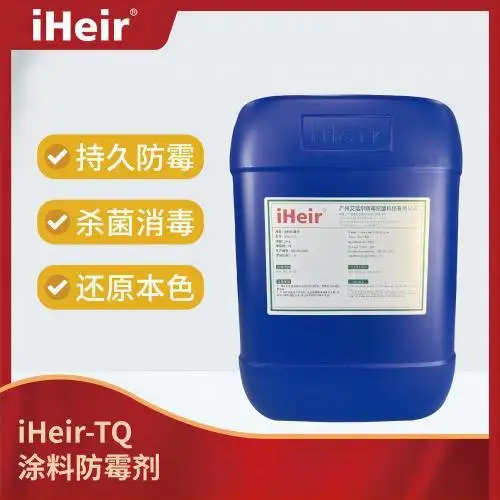
| Water-based (emulsion paint, stone paint, floor coating) | iHeir-TQ | 2-3% on total batch weight | Grind or let-down | 6-7 |
| Solvent-borne (wood and industrial paint) | iHeir-YQ | 1-1.5% on formula weight | Let-down | 4-7 |
| Alkaline, high-filler powder (putty, mineral coating) | iHeir-BCA | 0.5-0.75% of dry powder mass | Powder blending | 5.0-10.0 |
The logic behind the three rows is simple. The more water and organic content a system carries, the harder the in-can preservative has to work. The more alkaline it is, the less a conventional organic preservative can survive: putty and mineral coatings sit above pH 9, where ordinary preservatives break down, so the powder grade takes over. Where a customer needs both antibacterial and anti-mould test results on the same coating, run a formula trial with iHeir-Plus mould and bacteria inhibitor at 3%.
3. Rates by system: where to dose and at what level
Water-based systems run on TQ. iHeir-TQ covers the can and the film, with CMIT/MIT at 45% active content, dosed at 2-3% on total batch weight. Add it at the grind or let-down stage, where the batch is still fluid and shear is high enough to disperse the additive evenly. Dosing at the end of the batch leaves pockets of low concentration that still spoil. At the recommended rate the film keeps its protection for 5-10 years, and the product has a shelf life of one year or more.
Solvent-borne systems run on YQ. iHeir-YQ carries 79.5% active content and is dosed at 1-1.5% on formula weight across pH 4-7, covering the can and the film together. The rate looks lower than TQ because the active content is higher and the system carries no water. Handle it as an irritant: the neat liquid affects skin and eyes, so dosing needs goggles, chemical gloves and ventilation. Shelf life is three years or more.
Alkaline powder systems run on BCA. iHeir-BCA is a powder grade dosed at 0.5-0.75% of dry powder mass in the blending stage. It holds across pH 5.0-10.0 with a particle size of 4-30 micrometre and goes through the mixer with the fillers. It solves the long-standing problem of liquid preservatives that will not survive in an alkaline powder, and it removes a liquid dosing step from the line.
4. Six shop-floor steps from dosing to dispatch
- Measure three numbers first: pH, solids content and expected shelf life. pH decides the product, solids content decides the denominator, shelf life decides whether to take the upper end of the range.
- Get the denominator right: in-can protection is calculated on total batch weight, dry-film protection on formula weight. Keep the two figures separate in the batch record.
- Pre-mix before adding: dilute the additive into part of the batch or the water first, then add it to the main vessel, so the neat liquid does not hit high-solids material and form lumps.
- Watch temperature and shear: keep the batch temperature moderate at dosing so the active content does not break down early, and shear long enough for an even distribution.
- Hold a sample: keep a retained sample near 30C and watch for foaming, separation, thinning or odour before the batch is filled off.
- Control the warehouse: keep filled pails sealed and the store dehumidified, and add container desiccant sticks to export containers by container size.
5. How to verify: hold tests for the can, panel tests for the film
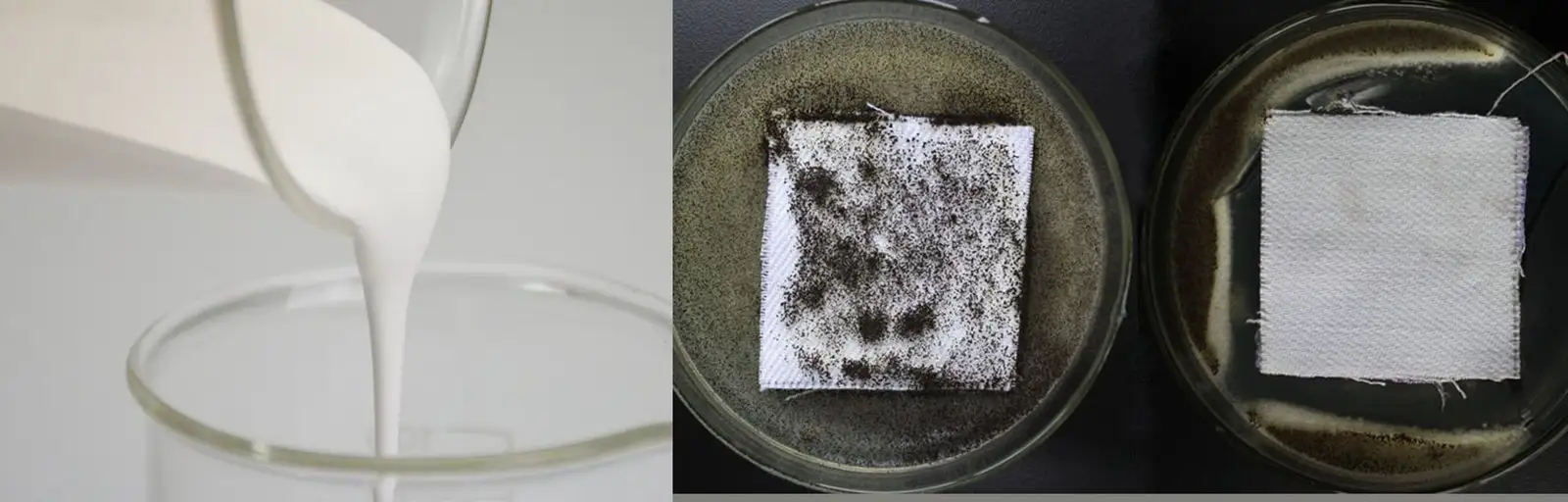
Use two different checks, and do not let one stand in for the other. For in-can protection, run retained-sample and accelerated storage tests: hold two samples from the same batch, one at ambient and one above 30C, and record how long each takes to smell or separate against an un preserved control. For dry-film protection, run a film anti-mould test: inoculate a coated panel with mould spores, incubate at controlled temperature and humidity, and grade the growth. It is also worth running water and alkali resistance on the same panels to confirm the additive has not changed the coating’s basic performance.
6. FAQ
Can an in-can preservative double as a dry-film fungicide? It depends on the product. iHeir-TQ is designed to cover both, but a preservative with no retention in the cured film will still let the wall go mouldy after application. Ask what the product is designed for before writing it into the formula.
Is a higher dose safer? Not necessarily. Above the recommended range the gain is small, while the risks to system stability, film appearance and cost are real. The better way to build margin is to dose earlier in the process and disperse properly, not simply to add more.
The water-based batch already smells sour. Can it be saved? Once there is a clear sour odour the microbial load is already high, and a top-up dose will only slow it down rather than recover it, so the batch is usually downgraded or reworked. For the diagnostic side, see water-based paint that smells mouldy after opening.
What about alkaline systems such as floor coatings? Start from iHeir-BCA powder with the rate and stage shown in the table above, and see anti-mould dosing in alkaline floor coatings for the formula side. If you are still choosing between additives, how to choose a paint anti-mould agent sets out the comparison.
The whole job comes down to one thing: write the in-can and dry-film lines into the formula and process sheets as two separate doses with their own denominators, stages and acceptance tests, rather than expecting one additive at one rate to solve everything. We recommend a lab trial to confirm compatibility and mould grade before scaling to production. iHeir-TQ, iHeir-YQ and iHeir-BCA are all available as samples with minimum order details, so talk to us about your specific system.