




 View Count:2
 Date:2026-10-23
How is a cooler box kept free of mould? First see which layer the mould comes from: the PU foam and the moulded shell are two different jobs. A container that spends forty days at sea can come back with musty liners, and the loss is the value of the whole shipment. The foam takes iHeir-FP at 0.5%-1.5% of foam weight, the shell takes iHeir-ECO at 0.3%-1.0%. This article covers the addition point and the process window for each.
1. A cooler box fails in two places, and the foam is where the water comes from
The box is three layers: shell, PU foam, liner. The shell is usually PP or PE, the liner is a smooth plastic part, and the PU is poured between them. Mould rarely grows inside the cells themselves. The problem is that the foam holds water: where the open-cell content is high and the warehouse is damp, the water the foam has taken up travels through the liner seams, the drain outlet and the hinge pockets to the inner surface, condenses as soon as the box sees a temperature swing, and the mould starts where the condensation sits.
The second place is the shell. Injection moulding and stacking leave fine scratches, dust and water collect in them in a damp store, and spots start from those lines. Mould on the shell does not touch insulation performance, but the customer sees the outside first. Both places need treatment, with an agent that suits each system.
2. Foam and compound: the two stages side by side
The table sets out both locations with the agent, the addition point and the basis for the calculation. The two are not interchangeable: one looks after the foam, the other after the shell, and leaving either out means the job is half done.
| Location | Material and process | Agent and level | Addition point | Basis |
|---|---|---|---|---|
| PU foam layer | Two-component foam | iHeir-FP 0.5%-1.5% | Polyol component, mixed before pouring | On total foam weight |
| Shell and lid | PP / PE injection | iHeir-ECO 0.3%-1.0% | Compounding or masterbatch | On part weight |
| Gasket | Rubber / elastomer | Carried with the shell batch | Same batch as the shell | On compound weight |
| Assembly and packing | Finished box | Desiccant and humidity control | Packing and loading | On box volume and container |
The difference is the basis and the temperature. Foam is a two-component metered mix, so the agent can only go into one of the two; injection is a melt process, so the agent has to survive the melt temperature. Both levels are calculated on weight, one on the foam, one on the part, and the two must not be quoted as one cost figure.
3. PU foam: 0.5%-1.5% of foam weight in the polyol
iHeir-FP foam antimicrobial agent is recommended at 0.5%-1.5% on the total weight of the foam. It is stable across pH 1-11, stable to light and heat, miscible with water in any proportion, and reaches an antimicrobial rate of up to 99.99%; oral LD50 in mice is above 5000mg/kg and the sensitisation rate in guinea pigs is 0%, so it falls in the practically non-toxic band. It ships in 25kg packs and should be kept sealed in a cool, dry place and used soon after opening.
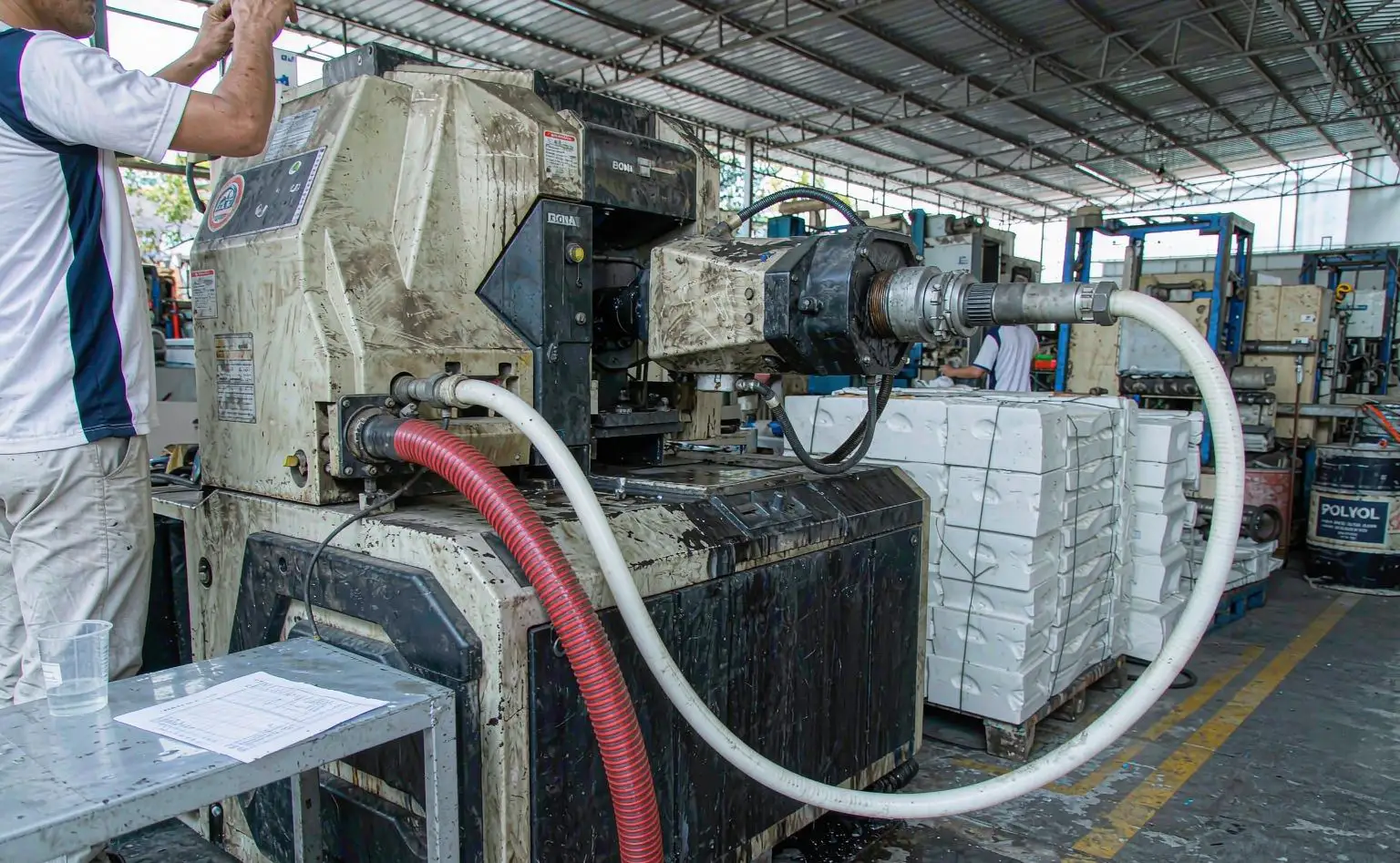
There is only one addition point: the polyol side. The foaming machine meters the isocyanate and the polyol blend separately and mixes them at the head, so the agent goes into the polyol tank ahead of time, is circulated until uniform, and then travels with the metered stream into the mix head. Pouring it into the mix head or into the mould does not work: the cream time is measured in seconds and the agent cannot disperse, so the block comes out patchy.
On level, work in three bands. Small boxes with thin foam and a low expansion ratio run 0.5%-0.8%; mid-size boxes 0.8%-1.2%; large boxes, long hold times and sea-freight orders run the top band of 1.2%-1.5%. The deciding number is foam density: at the same volume a heavier foam carries more agent, so a light foam goes to the upper band.
4. Shell and lid: iHeir-ECO at 0.3%-1.0% of part weight
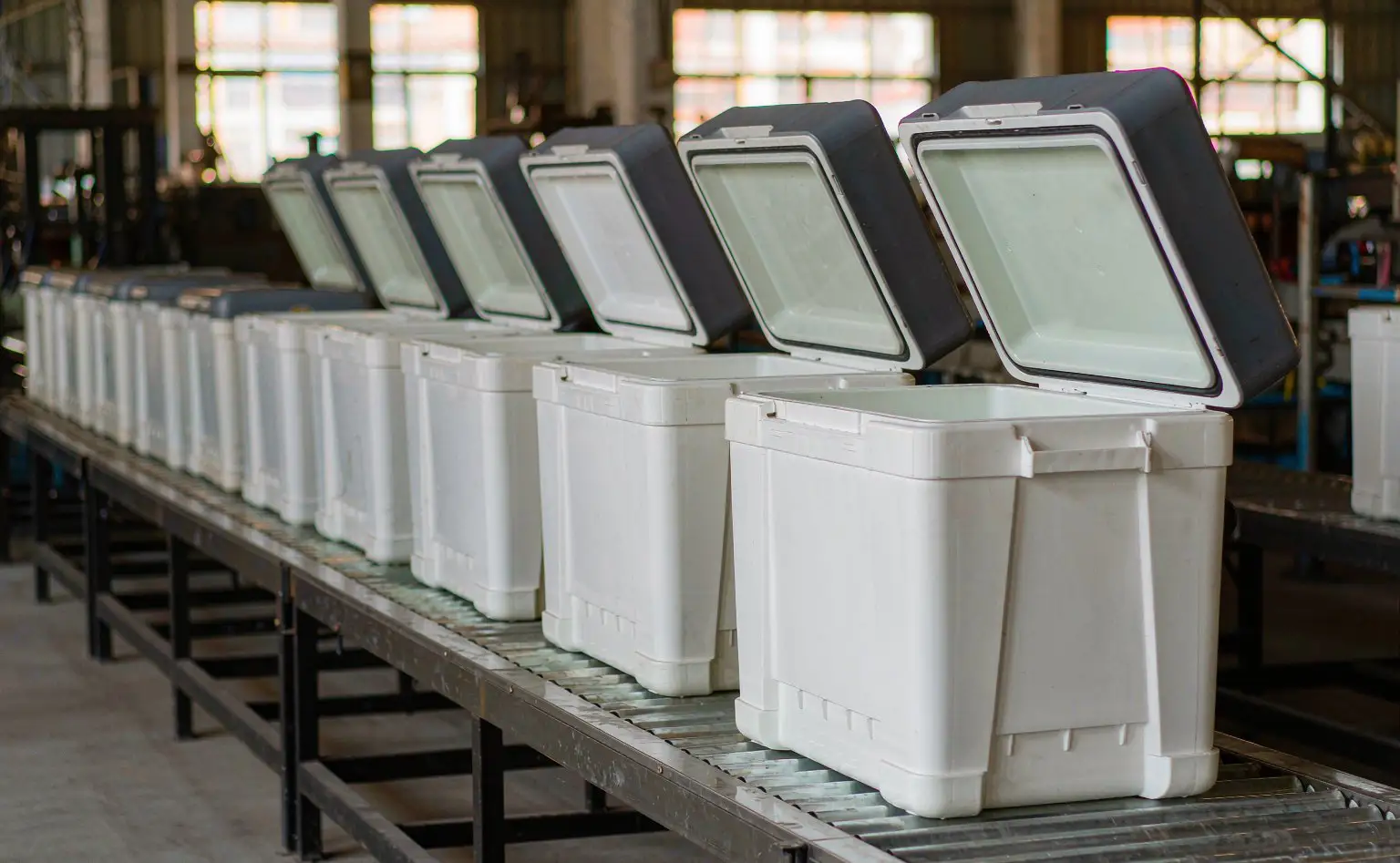
The shell takes iHeir-ECO plastic antimicrobial agent at 0.3%-1.0% of part weight, and a general polyolefin runs at 0.3%-0.5% at the bottom of that range. Thermal stability reaches 240C and the melt should be kept below 320C; food-contact testing covers GB 4806.7, EN1186 and LFGB, and oral LD50 is above 2000mg/kg. A cooler box holds drinking water, food and ice packs, so a food-grade grade is the sensible default.
Two ways to add it. The first is masterbatch: build a 2%-5% antimicrobial masterbatch and let the machine dose it into natural resin, which suits a plant running several machines and moulds off one formulation. The second is direct blending: tumble the powder with the pellets and feed the hopper, which suits a single machine on a single product.
Two details matter. Where the box has a clear viewing window, start at the 0.3% floor and check haze on a trial shot before committing; if haze fails the specification, leave the window without the agent and control that area at assembly instead.
5. Assembly and export: close the water path or the job is unfinished
The agent protects the material; the water path is a process problem. Three steps at assembly. The foam must be left to cure until its moisture content is stable before the liner goes in, because a liner fitted while the block is still warm seals the water inside the sandwich and no additive will hold that back. Wipe the inner face dry before fitting, since release agent residue draws moisture. And fit the gasket properly, then run a seal test on the closed box: a box that leaks air will take up water on the water.
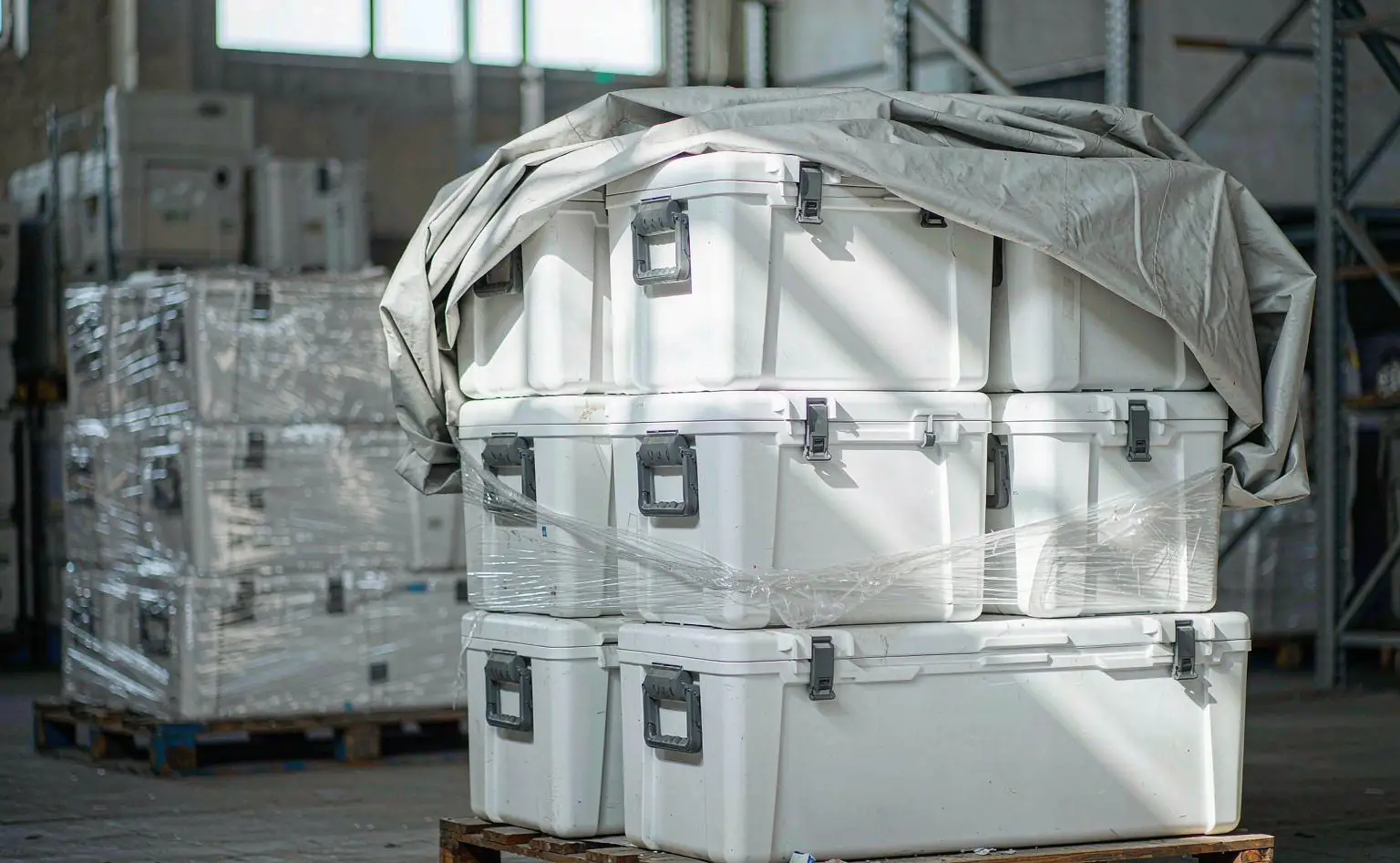
Packing and loading close the loop. Inside the box, add desiccant sized to the volume and leave gaps between boxes rather than wrapping each one tight, since film traps water against the surface. In the container, use absorbent material and keep a ventilation path between the cartons and the container wall; open two boxes and smell them before loading, and send any musty batch back to dry. In the warehouse, pallets off the floor, a gap to the wall and humidity held down; the details are set out in container moisture and mould in shipping and export warehouse mould control.
6. Questions we get: does the agent change the foam or the insulation value
At 1.5%, does FP disturb the expansion ratio or the cell structure? Added to the polyol at 0.5%-1.5% and circulated until uniform, the effect on the reaction is small. What really moves the cells is the water, catalyst and silicone balance in the formulation. Prove it with a paired trial on the same line, with and without the agent, comparing density and thermal conductivity.
With ECO in the shell, is the box still food-contact compliant? ECO itself carries GB 4806.7, EN1186 and LFGB test reports applied for by us, and those can be supplied to the customer as technical documentation. Whether the whole box is compliant depends on the resin, colour masterbatch and release agent as a set, so we recommend testing the finished box and can help arrange it.
Can we treat only one of the two? Foam only, and the shell still spots in the warehouse and fails inspection. Shell only, and the water in the foam still reaches the inner face through the seams. Both, plus the assembly and packing steps, is the only version that closes.
The four points to take away: iHeir-FP at 0.5%-1.5% of foam weight in the polyol, upper band for large sea-freight boxes; iHeir-ECO at 0.3%-1.0% of part weight, 0.3%-0.5% for polyolefins; count the regrind and check haze before running a clear window; cure the foam before assembly, leave gaps in the carton and control humidity in the container.


