




 View Count:22
 Date:2026-11-07
How is industrial fan mould handled? The blade is a PP part with glass fibre, so mould and bacteria come out of the compound, while the guard grille and the carton pick up moisture inside the box; mix the two routes up and the money is spent without the problem going away. The routine is iHeir-IPI001 zinc-ion antimicrobial at 0.8%-1.0% of the finished part weight in the compound, plus one iHeir-D vapour sheet in the carton at 0.1-0.2g of active matter per sheet. This article covers dosing, balance retesting and carton practice.
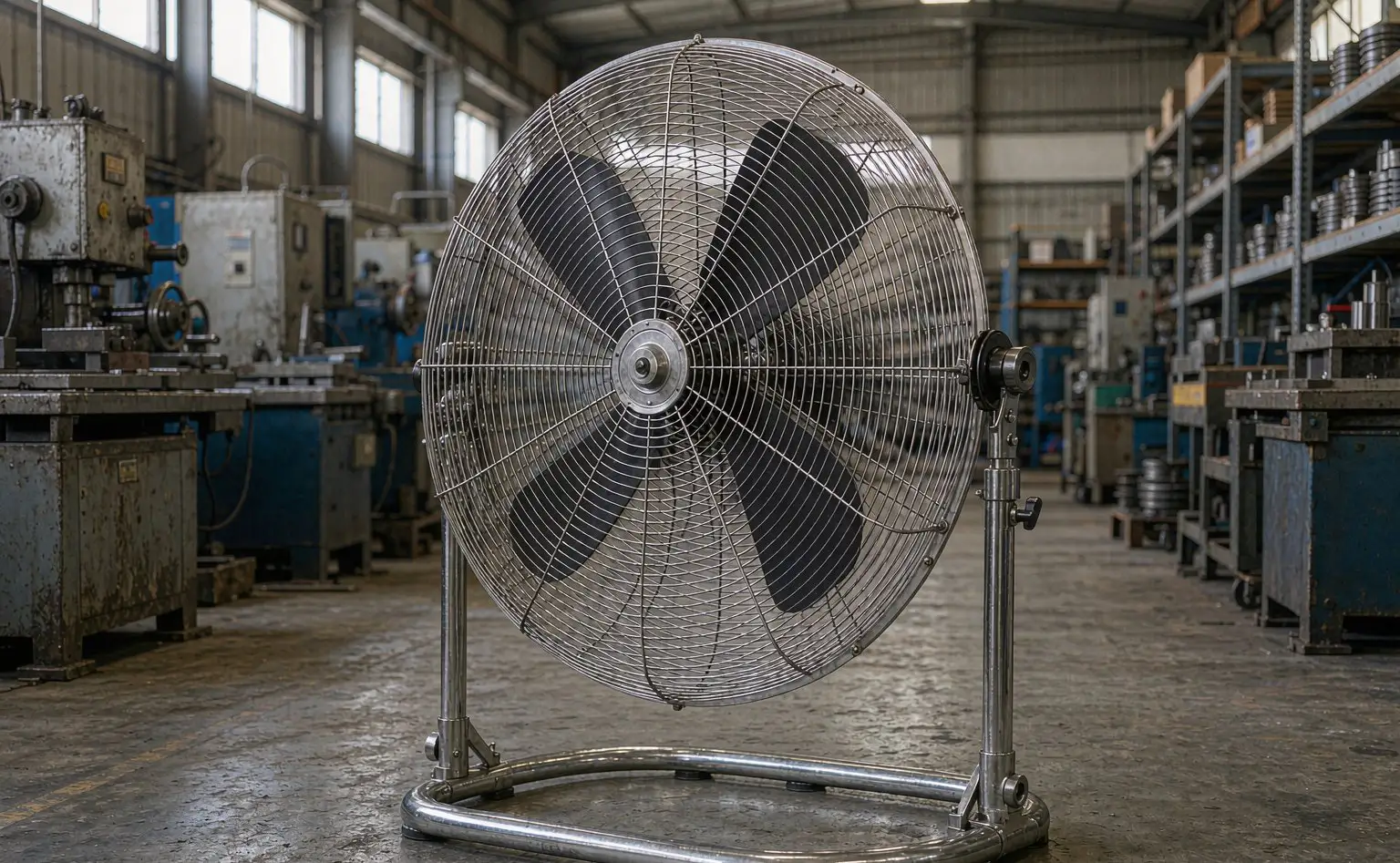
1. The blade is a PP part, and the mould comes out of the compound
Take an industrial fan apart: blade in PP or PP with glass fibre, hub, motor housing, metal guard grille, base, cable, carton and foam inserts. Metal does not feed mould; the two places that fail are the blade compound and the carton and foam.
Why the blade needs an antimicrobial at all. A blade runs for years in damp, dusty air, collecting a film of dust and water on the face where mould and bacteria settle. Paint does not solve it: once the film wears or blisters the substrate grows again, and a blister on a rotating part also upsets the balance.
In the compound beats on the surface. An antimicrobial inside the resin releases zinc ions slowly at the surface, so wearing through one layer exposes the next. That is why a machine that runs continuously and is never taken apart for cleaning gets its protection in the compound.
Glass-filled compound needs care. PP with glass fibre flows poorly and powder tends to clump. iHeir-IPI001 is a white powder at D90 below 3μm and a bulk density of 1.8-2.4g/cm3, so it disperses well, but feed it the wrong way and you get white specks or colour drift.
2. Blade and packing take separate counts
The table lines up the blade compound, the grille, the carton and the store. The compound is counted as a percentage of finished part weight, the paper in sheets of active matter, and the two are not convertible.
| Part | Material | Product and level | Stage | Control point |
|---|---|---|---|---|
| Blade | PP, PP with glass fibre | iHeir-IPI001 0.8%-1.0% | Mixing, pelletising or direct moulding | Of finished part weight, evenly dispersed |
| Hub and blade root | Same compound | Carried with the compound | Moulding | No short shots in thick sections |
| Metal guard grille | Galvanised wire | No anti-mould treatment | Plating, assembly | Dry before assembly |
| Carton and foam | Corrugated, EPS | iHeir-D 0.1-0.2g per sheet | Packing | Only works in a closed box |
One boundary. The IPI001 in the compound handles the blade itself, the vapour sheet handles the packing space. A well-dosed blade still lets the carton and foam mould, and a sheet alone leaves every colony on the blade face untouched.
3. Dosing the antimicrobial into the PP compound
The level is counted on finished part weight, and plastics and rubber both sit at 0.8%-1.0%. Thin-wall blades take the upper figure, thick hubs can take the lower, and an export order with an antimicrobial rate on the specification goes straight to 1.0% rather than somewhere in the middle.
How to feed it. With a pelletising line, make an antimicrobial masterbatch first and blend it with natural pellets, which disperses best. Without one, use a gravimetric side feeder ahead of the glass port so the screw has several zones to work with. Hand-scooping into the hopper is the worst option, because a few shots in every batch come out speckled.
Temperature is not the constraint. IPI001 is inorganic and heat-stable to 380℃, far above the PP window, and it carries no arsenic, no tin and no VOCs, so the shop-floor and compliance side is simple. What does need control is moisture: damp powder clumps, so finish an opened bag within the shift and store the rest sealed and dry.
Trial before you scale. Run one plate at 0.8% and one at 1.0%, measure antimicrobial rate, check colour difference and impact strength. On food-contact orders note that IPI001 can be used in food-contact applications, but the paperwork still has to match the market the customer ships to.

4. Retest balance and noise after moulding
Adding powder shifts density and shrinkage a little. On a rotating part that small shift shows up as vibration, so the moulding parameters are re-set: holding pressure and cooling time follow the new compound, not the old process card.
How to check balance. Work to the balance grade in GB/T 9239.1, once on the blade alone and again on the assembled fan. Out-of-tolerance parts go back to the tool and the flow, not to a balancing weight bolted on afterwards.
Noise retest. Measure the assembled fan at rated speed against the pre-change sample; a difference above 1-2 dB sends you back to blade profile and balance. Buyers inspect this item, so changing the compound without a noise check moves the risk to the inspection.
Appearance and colour. Pale blades show specks and drift worst, so clean the hopper and barrel before the run and purge with natural compound between colours.
5. Guard grille and carton: one sheet in the base
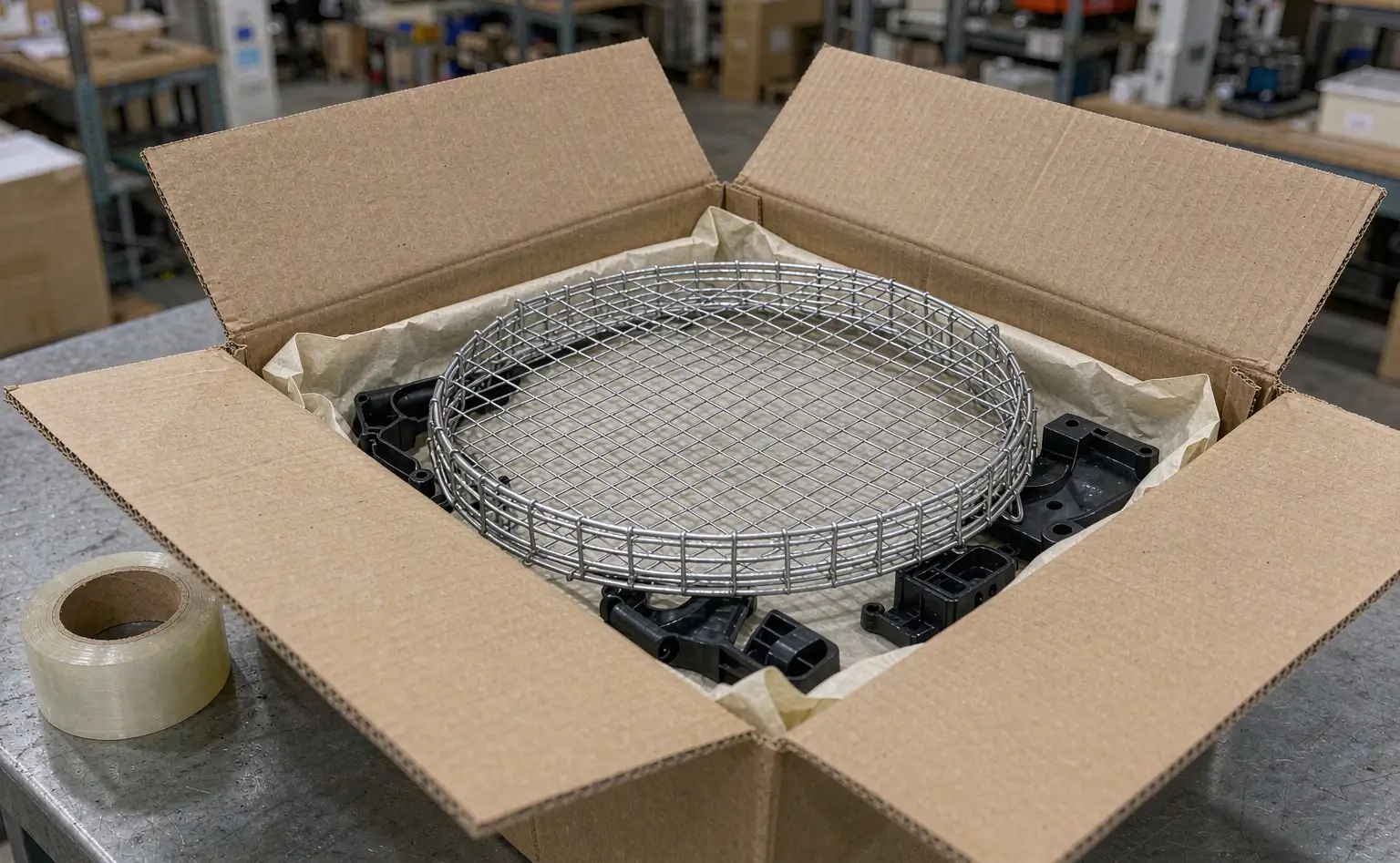
The guard grille is galvanised wire and does not mould, but the carton and the foam inserts do. Lay one iHeir-D vapour sheet in the bottom of the carton at 0.1-0.2g of active matter per sheet, and add one on the wall for a large carton or a multi-layer pack.
Why the base. The bottom of the carton is closest to the floor and takes water first, and foam inserts take up the most. A sheet in the base releases upward and covers the whole volume; a sheet taped to the lid leaves the bottom layer to mould as before.
Trial compatibility first. Seal three times the normal dose with a grille and a blade, mist a little water, separate with paper, and inspect after a few days for a dulled coating, a colour shift on the blade or a shrunken foam insert. iHeir-D carries 70%±5 solids and can corrode poor-quality metal when damp, so thin-plated grilles get the trial first.
Packing and storage. Cartons on pallets, 10cm off the floor and off the wall, store humidity below 60% RH, and seal the carton again after a sampling inspection, because half a day open exchanges the whole atmosphere. Other small appliance export lines run the same routine.
6. Questions on dosing, balance and sheets
Q: The blade is already painted, so is the compound dose needed?
Yes. Paint is a surface layer that stops working once it wears or blisters, while an antimicrobial in the compound keeps releasing at the surface.
Q: 0.8% or 1.0%?
Thin-wall parts, permanently damp duty and orders with an antimicrobial rate on the specification take 1.0%; thick parts and standard domestic models take 0.8%. Both are counted on finished part weight, not resin weight.
Q: Will the antimicrobial upset the balance?
Density and shrinkage move, so the process is re-set and balance is rechecked to GB/T 9239.1. Swapping the compound without touching the process is how vibration gets out of tolerance.
Q: Is one sheet enough for a grille carton?
For a standard carton one in the base is enough; add one on the wall for a large carton, thick foam or a long sea route. The box has to be sealed, because a loose carton will not hold the concentration.
Four points to take away: dose iHeir-IPI001 at 0.8%-1.0% of finished part weight, through a masterbatch or a gravimetric side feeder ahead of the glass port, and finish opened powder within the shift; re-set the moulding parameters and recheck balance to GB/T 9239.1 on the blade and on the assembled fan, with noise compared against the pre-change sample; lay one iHeir-D sheet in the carton base at 0.1-0.2g, one more on the wall for large cartons, after a three-times-dose compatibility trial; grade mould resistance to GB/T 24346-2009 and send antimicrobial rate to ISO 22196 or GB/T 31402. A kilogram of antimicrobial and a pack of sheets go out for a trial, with MOQ on the iHeir-IPI001 product page.


