




 View Count:26
 Date:2026-11-16
Why does meter box mould keep coming back after a season in the finished store? Because a batch of compression-moulded boxes sits closed for weeks, and the first thing the customer sees on opening is a sheet of white spots. The route is 0.8%-1.0% of iHeir-IPL inorganic antimicrobial compounded into the SMC, plus one iHeir-D sheet at 0.1-0.2 g per 0.01 m³ inside the enclosure. This article covers the mixing stage, the sheet count and the metal compatibility test.
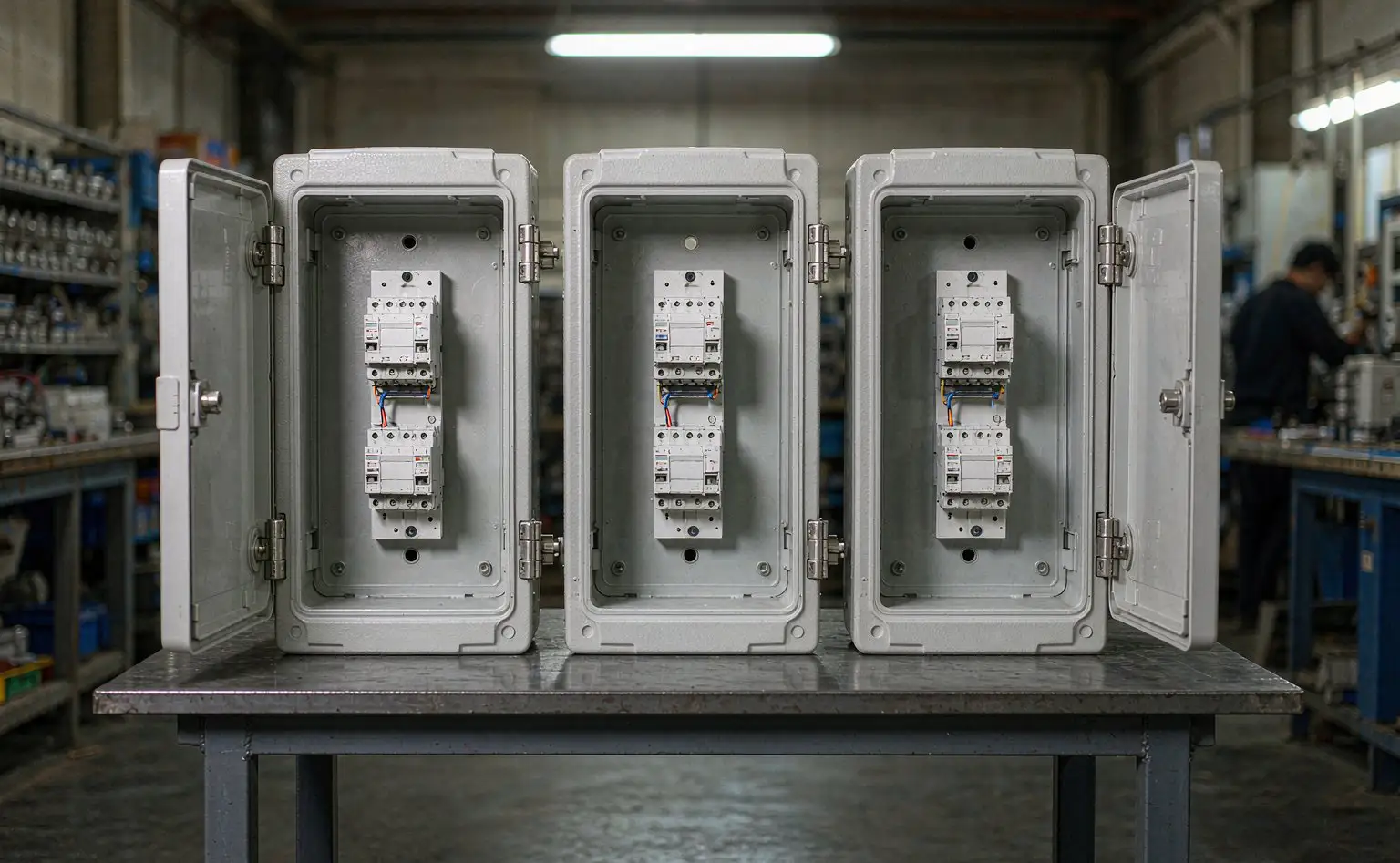
1. Where meter box mould comes from: shell, cavity, rails and terminals
Single-phase and multi-position meter boxes are usually SMC pressings: unsaturated polyester with glass fibre and filler, moulded as shell and door, with rails, terminal blocks, a transparent window and sealing points fitted afterwards.
The moulded surface is the first place. An SMC part comes out dense, but release agent left on the tool lowers surface energy in patches, and sanding flash adds dust. Once the store turns humid, spots appear along the inside of the door, at the root of the stiffening ribs and around the lifting holes, because those are where condensation lands.
The cavity is the second and the most overlooked. With the door closed the box is a semi-enclosed space that may stand empty for weeks or months. Air moves in and out with the day-night swing, water condenses on the inside of the wall, and the rails, terminals and the back of the window all sit in that damp air.
Rails and terminals are the third. Galvanised rails and copper terminals hold water in slot gaps and screw holes; growth starts at the slot mouth and climbs the terminal; above 75%RH it spreads visibly in about two weeks.
2. How to add it: 0.8%-1.0% of part weight at the mixing stage
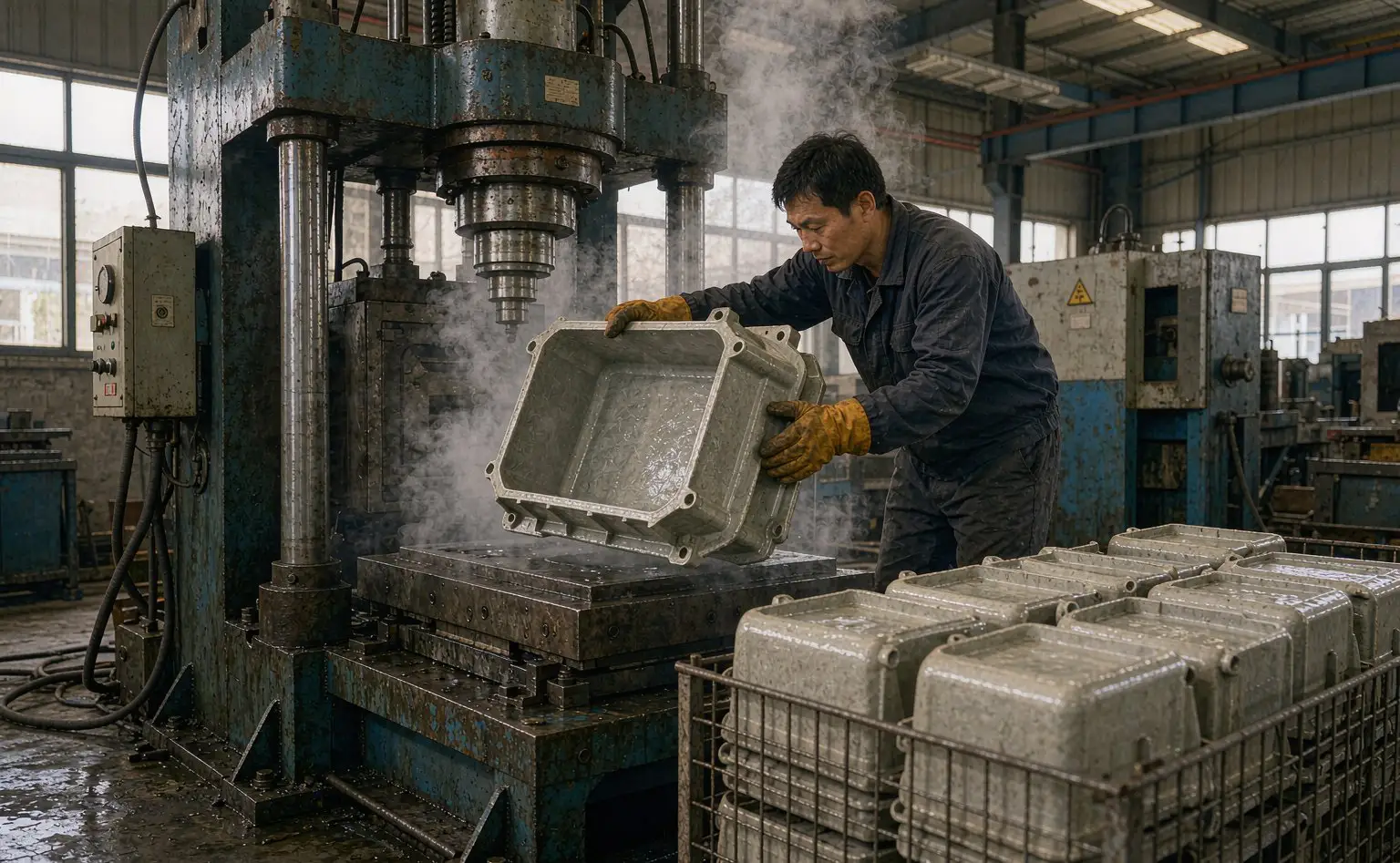
For an SMC part the correct entry point is the compound mixing stage, not a spray after moulding. The shell is dense and carries release agent, so anything sprayed on sits on the surface and wipes off before the meter is fitted.
Where it goes. At the resin paste stage, charge iHeir-IPL together with filler, internal release agent and thickener. Pre-disperse it in a small portion of resin first, then add to the main paste, so the powder does not clump. Glass fibre is wetted after the paste, so the antimicrobial is carried onto the fibre and ends up distributed through the wall section.
How much. 0.8%-1.0% of total part weight, with the upper end for light-coloured shells. IPL is a white powder with whiteness above 90 and a mean particle size of 1-2 μm, so grey and beige shells keep their appearance; specific surface is 10-15 m²/g, and when dispersed properly it does not leave bright specks on the face.
The temperature line. IPL withstands 300℃ and can take a 300-320℃ window, while SMC moulding runs at 140-150℃, so there is plenty of margin. What needs watching is dispersion and cure: undispersed powder creates local over-concentration, which shows up as white specks and shade variation. Check dispersion on one batch and press three sample plaques for a visual comparison before committing the recipe.
3. How many sheets inside: one per 0.01 m³, fitted before the door closes
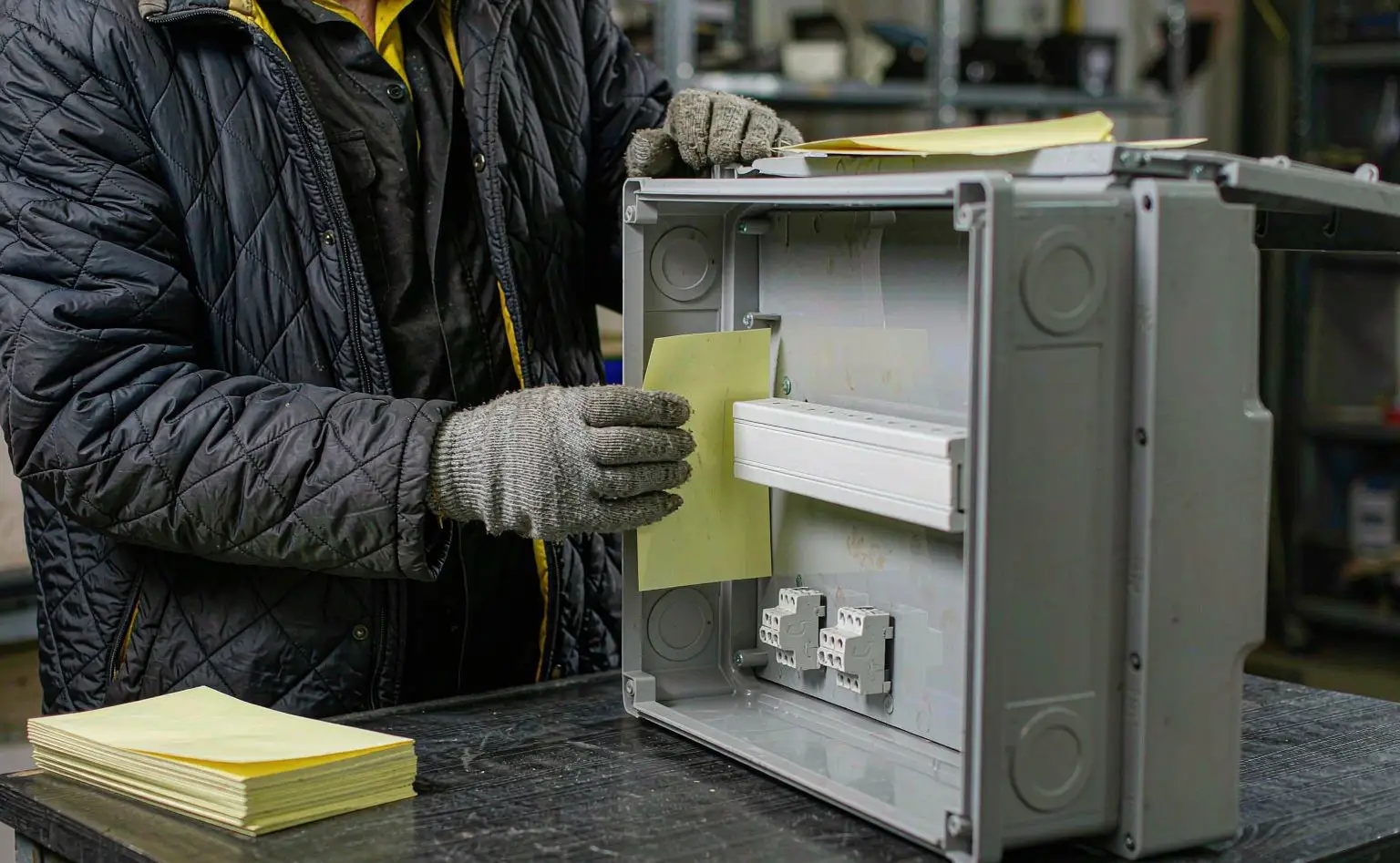
The cavity is covered by vapour-phase paper, which releases slowly into a closed space. The count follows cavity volume, not box weight.
Working out the count. Measure the clear internal length, width and height and take the volume. A single-position box is usually 0.015-0.02 m³ and takes two sheets; a three-phase multi-position box at 0.04-0.06 m³ takes four to six. Each sheet carries 0.1-0.2 g of active, and one goes at each end rather than all in the same corner.
Where to put them. On the inside upper edge of the door, on the upper part of a side wall, or inside the document wallet that ships with the box. Never on the terminal block and never pressed into a rail slot, because those are torqued and loaded with a meter, and a torn sheet is a dead sheet.
It has to be closed to work. The active is volatile, so a box standing with its door open is wasting the sheet. Close the door as soon as assembly ends and fit the sealing point; bag finished boxes or wrap the pallet, because three days open in the store empties the sheet.
| Part | Material | Product and level | Stage | Control point |
|---|---|---|---|---|
| Shell and door | SMC moulding | iHeir-IPL 0.8%-1.0% of part weight | Resin paste mixing | Pre-dispersed, moulded at 140-150℃ |
| Cavity | Closed space | iHeir-D one sheet per 0.01 m³ (0.1-0.2 g) | Before the door closes | Counted on clear volume, off the terminals |
| Window | PC or PMMA | No separate additive, follows the shell | Moulding and assembly | Transparency and reading unaffected |
| Rails and terminals | Galvanised steel, copper | No additive, humidity control and a paper barrier | Assembly and storage | Sheet off the terminals, compatibility first |
One boundary. The compound covers growth on the shell, the sheet covers the vapour left in the cavity, and rust on rails is a job for humidity control. None replaces another.
4. Prove metal compatibility: three times the dose, seven days
Vapour-phase paper can corrode poor-quality metal in damp conditions, and a meter box carries a lot of metal: galvanised rails, copper terminals, screws, sealing screws.
The method. Take three rail sections, three terminals and three screws from the same batch, seal them in a PE bag with iHeir-D at three times the normal dose, and hold at 40℃ and 90%RH for seven days. Then inspect for dulling, clouding or a hazy bloom on the plating and for rust inside the threads.
Reading the result. Plating that matches the control means the normal dose is fine. Slight dulling means moving the sheet to the inside of the door with a neutral paper between sheet and terminal. Rust means dropping the sheet from the cavity, keeping it in the document wallet and controlling humidity instead.
5. Assembly and the finished store: keep the water out before packing
The assembly shop is harder to control than the press shop, and in the humid season a sweating floor puts a film of water on boxes that stand on the line.
Hold the line below 65%RH. Bring boxes down to room temperature in a dry area before assembly rather than pushing hot shells into a humid shop, because the moment the temperature difference appears the inside of the wall condenses.
Store and ship. Keep the finished store below 60%RH, pallets 10 cm off the floor and 30 cm off the wall, and open two boxes before container loading to check the rail slots and the back of the window for smell and hazy plating. Comparable practice on adjacent equipment is in switchgear cabinet humidity control and transformer pressboard and wooden crate.
6. Questions from the line
Q: Can we just spray an antimicrobial on the finished box?
A: No. The dense SMC face carries release agent, so a spray wipes off before the meter goes in and never reaches the growth source in the wall. Compound it at the mixing stage.
Q: 0.8% or 1.0%?
A: On total part weight: 1.0% for light shells and humid export routes, 0.8% for dry inland regions. Press three sample plaques for appearance and cure before fixing the bulk recipe.
Q: How much space does one sheet cover?
A: One sheet per 0.01 m³ at 0.1-0.2 g, more where the cavity is large or the door seal is loose, never one sheet for a multi-position box.
Q: Will the sheet blacken the terminals?
A: Not at the normal dose, but thin plating is sensitive. Run the seven-day bag test at three times the dose and move the sheet to the inside of the door with a paper barrier if colour shifts.
Four closing points: compound iHeir-IPL at 0.8%-1.0% of part weight into the resin paste, pre-dispersed before the main mix, and mould at 140-150℃; count iHeir-D at one sheet per 0.01 m³ of clear volume at 0.1-0.2 g, fitted before the door closes; run the metal parts through a seven-day bag test at three times the dose and keep the sheet off the terminals; hold assembly below 65%RH and the store below 60%RH, and open two boxes before loading. Performance can be verified to GB/T 31402 and ASTM G21, and lead times are on the iHeir-IPL product page.


