




 View Count:4
 Date:2026-11-11
How should office chair mould be treated? Once the mesh seat or the cushion foam goes mouldy, the whole run sits in the warehouse for a month and ships as seconds. The routine is iHeir-BJ textile mildew inhibitor at 2%-3% o.w.f. on the dry fabric weight in the stenter bath, plus iHeir-FP foam antimicrobial at 0.5%-1.5% of foam weight before the foam is moulded. This article gives the levels, the bath conditions and the packing control points.

1. Mould lands on the mesh, the foam and the carton, not on the armrests
Take a mesh task chair apart: mesh seat, mesh back, cushion foam, armrests and castors in glass-filled PP, gas cylinder, carton and EPE. What moulds is the mesh and the foam; the moulded parts are glossy and take up little water, so they come last in the queue.
The mesh shows white specks first. It is polyester, or polyester with nylon, and it comes through weaving, dyeing, stentering, cutting and sewing carrying size, oil, hand sweat and water in the gaps between yarns. Two days on a cutting rack in a humid season and grey-white spots appear, and by the time the panel is sewn onto the chair the whole unit is a rework.
The foam moulds from the inside. A cushion is open-cell polyurethane. It takes water in, feels dry on the surface and still holds water inside. A month under compression shows nothing, then the customer opens the carton to a musty smell, cuts the cushion and finds the cell walls black. That part cannot be washed, only replaced.
The carton seals the water in. Chairs go into a carton with EPE above and below, and the box is a closed volume. Over a month or two at sea it condenses water inside, and the spots usually appear on the side that faced the carton wall.
2. Mesh and foam are counted on two different bases
The table lines up the mesh, the foam, the moulded parts and the packing. The mesh is counted as o.w.f., on dry fabric weight; the foam is counted as a percentage of the total foam mix. The two percentages are not the same quantity and one figure cannot be used for the other part.
| Part | Material | Product and level | Stage | Control point |
|---|---|---|---|---|
| Seat and back mesh | Polyester mesh | iHeir-BJ 2%-3% o.w.f. | Stenter bath | Bath 21-50C, pH 4.5-8.5 |
| Cushion foam | PU flexible foam | iHeir-FP 0.5%-1.5% | Before foaming | Of total foam mix, trial first |
| Armrests and castors | PP+GF, nylon | No dosing | Moulding | Clean surface, no release agent |
| Carton and EPE | Corrugated, EPE | Humidity control only | Packing | Board moisture, pallet off floor |
One boundary. iHeir-BJ works inside the yarn and deals with what grows in the fibre; iHeir-FP works inside the foam and deals with the cell walls; the carton stage has no product at all, only humidity and stacking discipline. The first two last for the life of the chair, the carton only covers the voyage.
3. Running the mesh seat through the bath at 2%-3% o.w.f.
The level is 2%-3% of dry fabric weight. Domestic orders in dry regions take the low end; export orders, coastal customers and buyers with a mould test take the high end. Three kilos of inhibitor treats a hundred kilos of fabric at 70% pick-up, and that ratio is how the batch figure is worked out.
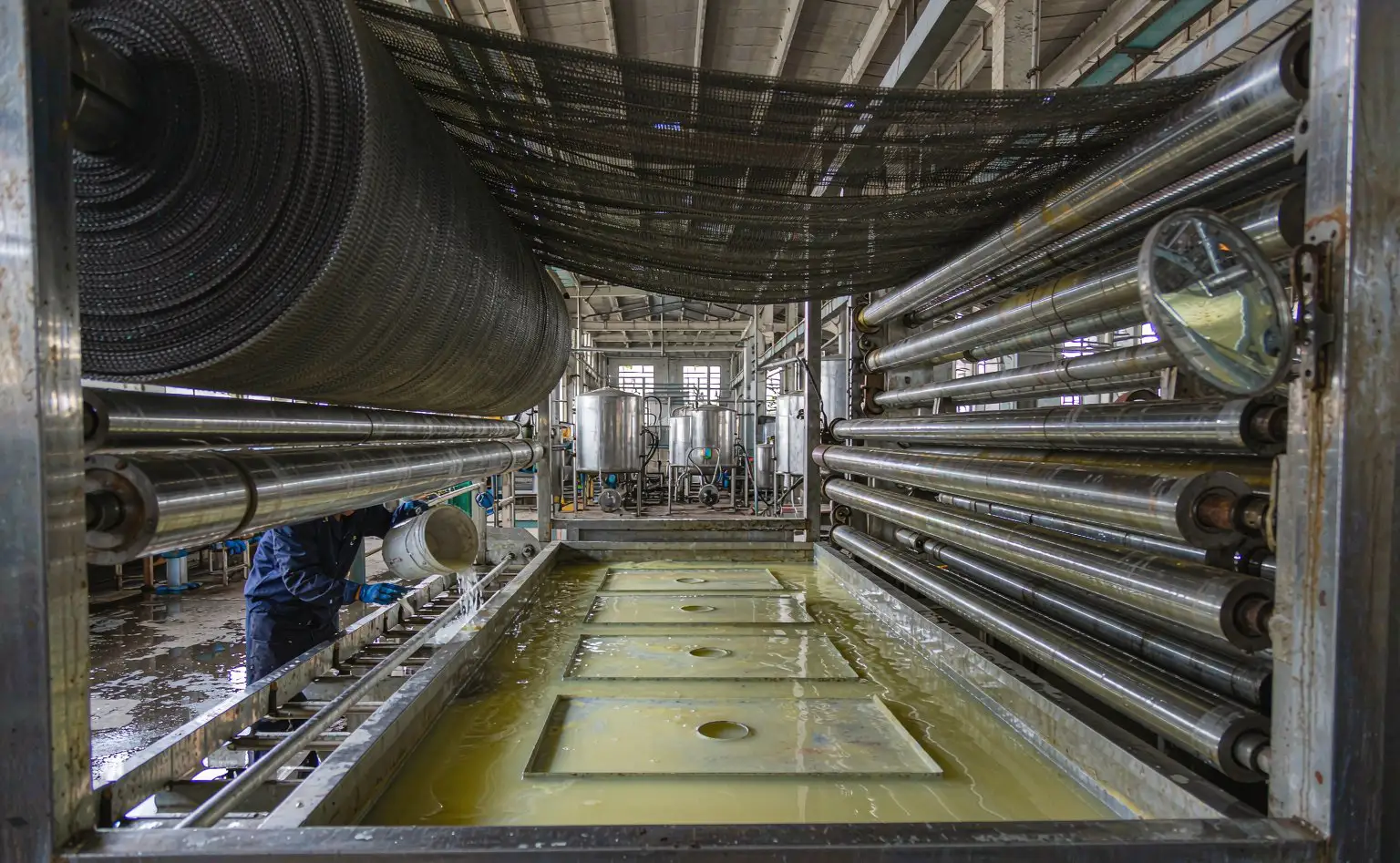
Add it in the stenter bath. iHeir-BJ is a water-soluble liquid, diluted with clean water and charged to the stenter; the fabric passes through once and goes into the dryer. Do not spray it on after coating. Mesh is often given a flame-retardant or water-repellent finish, and once that film forms the agent cannot reach the fibre.
Do not skip the pre-mix. Pre-mix the inhibitor with 9-13 times its weight in water and charge it in portions; adsorption evens out and the fabric does not go patchy in shade or stiff in hand.
Bath conditions. 21-50C and pH 4.5-8.5. Set the make-up water to pH 4-6, add 0.1% cationic hydrophilic agent (70 g in 67 kg of water) and then the inhibitor; the fabric wets out better and the take-up is more even.
The failure that bites most: never share the bath with an anionic auxiliary. iHeir-BJ is cationic. Put it in with an anionic softener or an anionic water repellent and the two complex out of solution, the bath throws a scum, and the anti-mould effect goes with it. Run softening and repellency as separate passes, or move to a non-ionic system.
4. Dosing the cushion foam with iHeir-FP at 0.5%-1.5%
The foam stage can only be treated before it foams. The level is 0.5%-1.5% of total foam mix: 0.5%-1.0% for ordinary cushions, up to 1.5% for export, humid regions and buyers who test for antimicrobial performance.
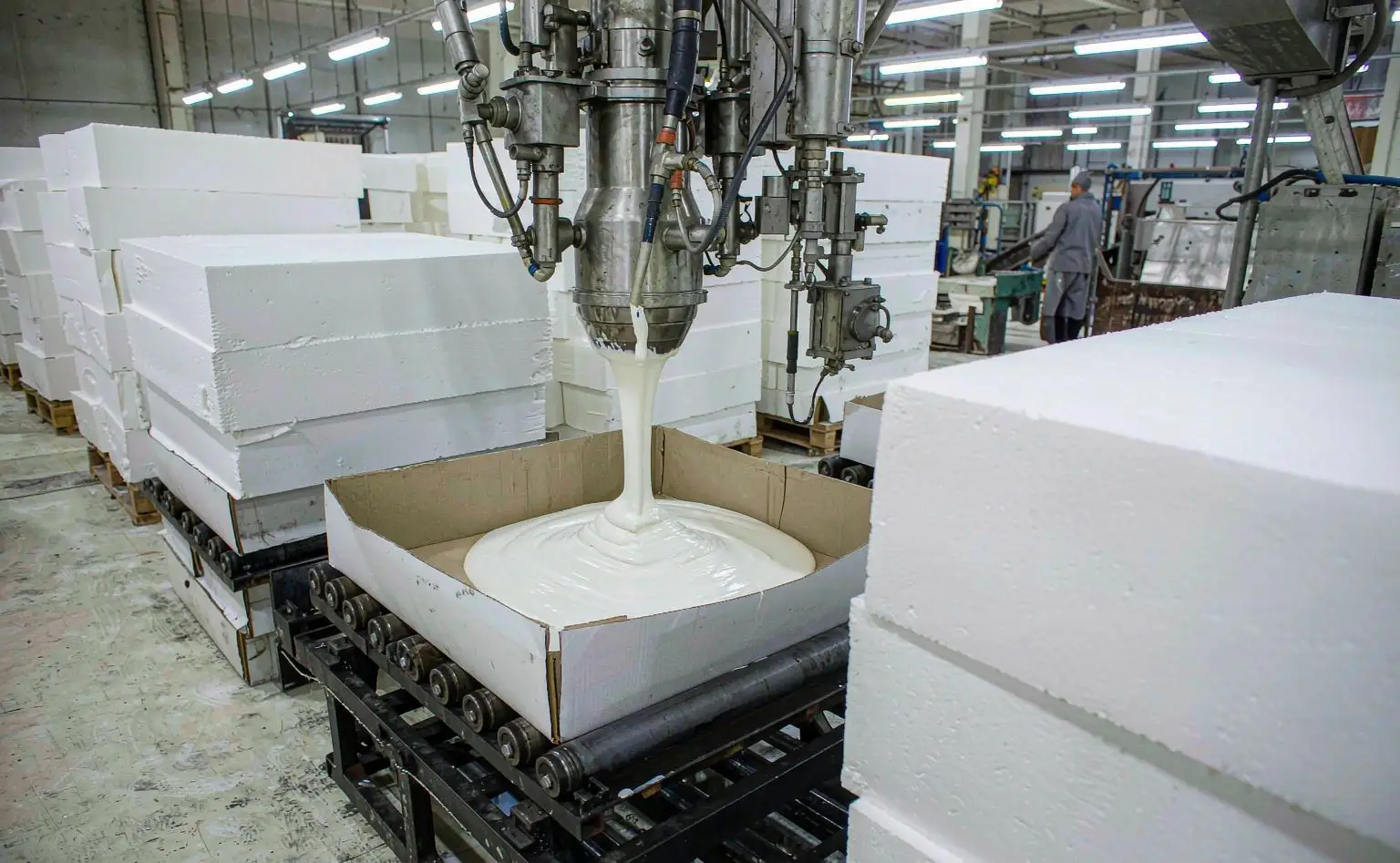
Where it goes. Into the polyol component, dispersed evenly before the mix head. Cell structure forms in tens of seconds, and anything added once the reaction starts will not distribute, so the agent has to be in the tank before foaming begins.
What iHeir-FP is. A clear, odourless liquid, stable from pH 1 to 11 and tolerant of light and heat. Laboratory figures put the antimicrobial rate up to 99.99%, oral LD50 above 5000 mg/kg, skin irritation score 0 and sensitisation rate 0%. In a cushion it does not change the smell, which matters in office furniture.
Trial four things. Resilience and hardness to GB/T 6669 and GB/T 10807; density and whether the cell structure shifts; the surface, looking for collapse, closed cells or coarse cells; and shade, since light grey and beige foams show a colour shift most.
5. Assembly, warehouse and export: do not let dried parts re-absorb
If the fabric and the foam are right and the next three stages are loose, the money is spent for nothing.
Moisture content. Fabric leaving the dryer is checked by hand and by moisture content; before cutting it should feel dry and slightly rough, not tacky. Foam cures 24 hours after demoulding before cutting.
Shop humidity. Hold cutting, sewing and assembly at 45%-60% RH, and cover part-finished units with PE film overnight instead of leaving them open on racks.
Finished goods. Keep the warehouse below 60% RH, pallets 10 cm off the floor and 10 cm off the wall, stacks no more than six high. Walk the stock before the humid season and open cartons to check the back of the mesh and the underside of the cushion. Stacking and grading for similar furniture sit in office furniture gone mouldy, and the foam side in foam back panel and shell fabric.
Export. For full containers, line the floor with barrier film and hang desiccant sticks, and check every carton for soft corners before loading.
6. Questions on baths, foam and rework
Q: The mesh already has a water-repellent finish. Can the inhibitor still go in the same bath?
Change the order. Run anti-mould first and repellency second, as two passes; if the repellent is anionic, wash off in between, otherwise the cationic iHeir-BJ complexes with it and the bath throws scum.
Q: 2% or 3%, a factor of one and a half?
Follow the market and the acceptance test. Domestic, dry, fast turnover takes 2%; export, coastal sites and buyers wanting a mould report take 3%. Both are on dry fabric weight, not bath volume.
Q: The chairs have already moulded in the warehouse. Can they be reworked?
The mesh can be replaced, a mouldy cushion cannot be saved. Washing does not reach the roots inside the cells and the smell returns within two weeks. Isolate the rework lot and never mix it back into first-quality stock.
Four points: run the mesh at 2%-3% o.w.f. in the stenter bath with iHeir-BJ, hold the bath at 21-50C and pH 4.5-8.5, pre-mix in 9-13 times water, add 0.1% cationic hydrophilic agent, and keep anionic auxiliaries out of the bath; disperse iHeir-FP at 0.5%-1.5% of foam mix into the polyol before foaming, with a trial for resilience, density, cells and shade; hold cutting and assembly at 45%-60% RH and cure foam 24 hours before cutting; keep the warehouse below 60% RH on pallets off the floor, and line and dry containers for export. Mould resistance goes to GB/T 24346 and antimicrobial performance to GB/T 20944.3, and a kilo sample goes out first, with MOQ on the iHeir-BJ product page.


