




 View Count:10
 Date:2026-09-15
Silicone parts come out of the finished-goods store and a carton is opened before shipment. Pale spots have appeared on the surface. The workshop reaches for mould remover on instinct. Some parts come back looking new; others turn cloudy, go tacky and pick up wipe marks that were not there before. The problem is diagnostic, not chemical: at least two very different things produce pale spots on silicone, and the wrong treatment turns usable parts into scrap.
1. Separating mould spots from bloom
Silicone offers mould nothing to eat, but the white oil, silicone oil, release agents and low-molecular additives dosed during compounding migrate to the surface and bloom there when temperature shifts. Bloom looks a great deal like mould. Two criteria separate them: how the mark reacts to wiping, and where it sits.
| Feature | Mould spots | Bloom |
|---|---|---|
| Colour and form | Grey-white, grey-green to black, dots or threads, irregular edges | White powder or film, evenly spread, soft edges |
| Reaction to wiping | Comes off as coloured residue, substrate stays sound | Comes off, then returns in the same place within days |
| Typical location | Carton contact faces, stacked faces, poorly ventilated areas | Thick sections, parting lines, near the gate |
| Smell | Noticeable musty or earthy odour | Odourless, or faintly oily |
| Root cause | Storage humidity above 75%, condensation followed by colonisation | Migration of white oil, silicone oil and release agents |
| Right response | Clean and rework, protect the next batch | Adjust the additive balance; anti-mould agents cannot help |
Work in that order: smell first, then wipe, then watch for regrowth. If it is still unclear, leave one part at 30 degrees C and 85% relative humidity for seven days. Bloom looks the same as it did; mould spreads visibly. That test costs almost nothing and prevents a whole batch being handled the wrong way.
2. Rework or scrap: grading silicone parts
Once mould is confirmed, grade by how far it has gone. Surface growth wipes clean with a flat substrate and no tackiness, and can be reworked. Light penetration leaves a pale trace or slight loss of gloss, and the part can be downgraded for non-visible surfaces or non-critical orders. Heavy penetration shows broad patches, a tacky or fuzzy surface, fine crazing, or an obvious change in hardness, and should be scrapped outright.
That last point matters more on silicone than on rigid plastic. Once the surface goes tacky, the cross-linked network has been affected by microbial metabolites, and even if appearance is recovered, sealing performance and rebound are no longer controllable. Parts used as seals carry the highest risk.
Rework should be gentle. Load a soft cloth with a small amount of cleaner, wipe the affected area, and repeat on stubborn spots without aggressive abrasion. Silicone is softer than rigid plastic, and heavy rubbing leaves permanent marks that turn a reworkable part into scrap. Dry thoroughly afterwards, because residual moisture is the direct trigger for the next round of growth.
3. What makes antimicrobial silicone different, and what to dose
The difference comes down to one thing: whether an antimicrobial active was added to the compound during mixing. Ordinary silicone resists growth only passively, because the material itself offers no nutrients. Put sweat, oil or packaging bloom on the surface and organisms colonise it just the same. Antimicrobial silicone carries a dispersed active throughout the compound, so the part resists growth as a material rather than relying on a surface coating.
The first selection criterion is the cure system. Platinum-cure (addition-cure) silicone uses a catalyst that is extremely sensitive to sulphur and amine compounds, which poison it. The symptoms are incomplete cure, a tacky surface and reduced rebound. When choosing an antimicrobial for platinum-cure silicone, confirm the grade contains neither sulphur nor amines. This is the trap most plants hit when they switch suppliers.
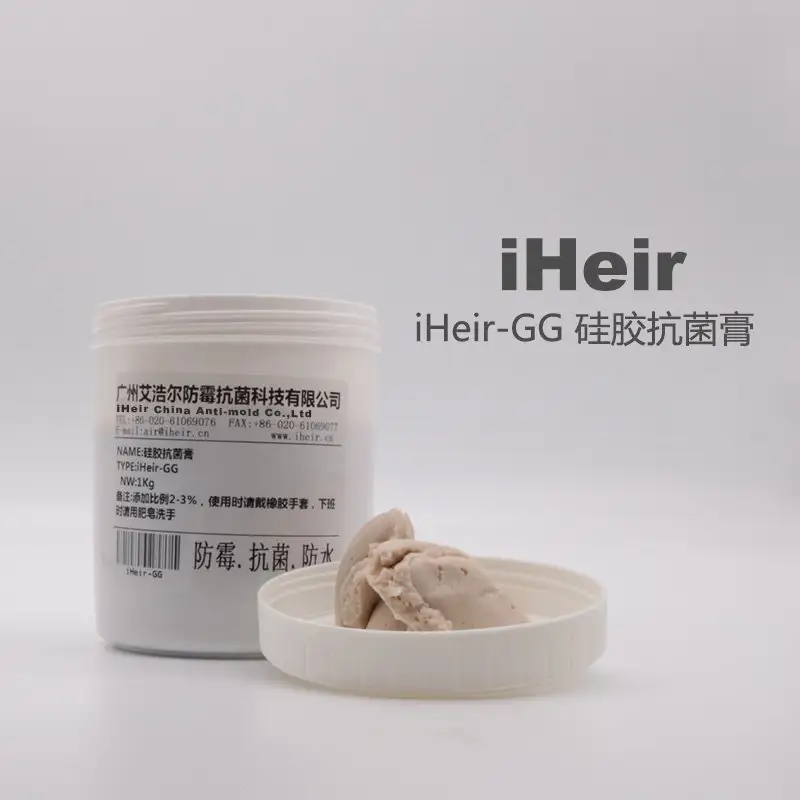
The second criterion is clarity and colour. Transparent and light-coloured parts cannot use a grade that hazes or yellows the compound. iHeir-GG907 silicone rubber antimicrobial cream suits silicone parts generally, with a total active content of 50%, dosed at 1.5%-2.0% of total silicone weight during compounding and blended evenly into the rubber. For light and transparent parts, use iHeir-GGIPL silicone antimicrobial paste, which delivers at least 99.99% reduction against E. coli, Staphylococcus aureus, Pseudomonas aeruginosa, Aspergillus niger and Candida albicans, dosed at 2%-3% during compounding. Where the target is preventing degradation, discolouration and odour, use iHeir-GGTK silicone antimicrobial agent, dosed at 1%-2% of total product weight directly into the system under even stirring, with a recommended working temperature no higher than 200 degrees C.
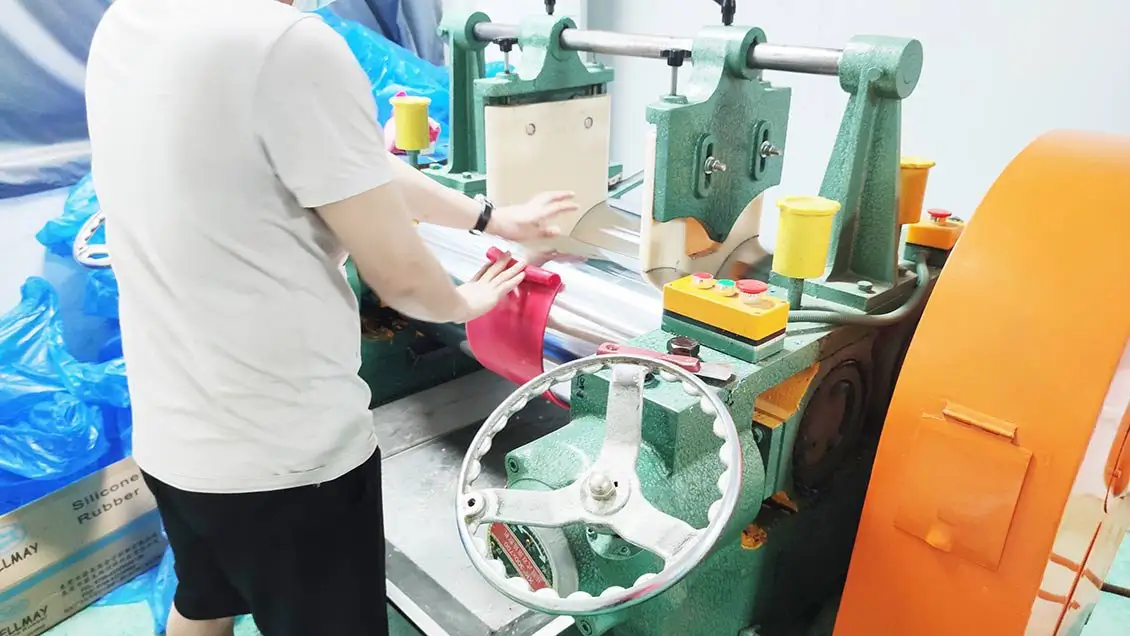
The addition must happen during compounding, dispersed as the batch turns. Tipping it in at the end leaves paste that cannot disperse evenly, which shows as localised haze on the part and a failed antimicrobial result. For exact dosages on a specific formulation, work with the supplier’s technical centre on a formulation trial; it is far faster than trial and error in production.
4. Do not trade performance for protection: what to re-test
Adding an antimicrobial to silicone means verifying three things at once. Skipping any of them tends to surface later, either on the line or at the customer.
Mechanical properties. Re-test Shore hardness, tensile strength and elongation at break against an unmodified control. A hardness shift above 3 points or a tensile loss above 10% means the loading is too high or the grade is incompatible, and both need correction.
Optical properties. Re-test light transmission and haze on transparent parts, and colour difference on light parts. Haze climbs as loading rises, which is why transparent work starts at the bottom of the recommended band.
Cure and rebound. Platinum-cure compounds in particular need a check on cure state and compression set. Under-cured parts reach the customer as tacky, oily or dimensionally unstable goods.
With those three in hand, purchasing has a basis for comparison that is not simply price per kilogram. What matters is the loading needed to hit the same antimicrobial rate. At 1.5%-2.0%, the additive cost per silicone part typically lands in the range of a few cents and stays under 1% of the ex-works price, while a rejected batch of seals costs the full shipment value.
5. Proving it: ASTM G21 and ISO 22196
Mould resistance is reported as a grade against ASTM G21, the standard for determining resistance of synthetic polymeric materials to fungi, where grade 0 or 1 is the usual export contract requirement; ISO 846, the evaluation of the action of microorganisms on plastics, can be reported alongside it. Antibacterial performance is reported against ISO 22196, the measurement of antibacterial activity on plastics and other non-porous surfaces, with an in-house threshold normally at 99% or above. The two cover different organisms, and export orders frequently ask for both.
Three points matter when submitting samples. Take parts from the same formulation and the same cure conditions. Submit treated and blank samples together so the report carries a real comparison. And keep a sufficient accelerated storage set at 30 degrees C and 90% relative humidity for 28 days, photographing it on a fixed schedule. For a wider comparison of silicone and rubber antimicrobial options, read our silicone anti-mould guide. For how the grading behind those reports is structured, see mould resistance grades explained.

6. Frequently asked questions
Q: Can you tell antimicrobial silicone from ordinary silicone by eye?
No. The active is dispersed through the compound, so appearance and feel are identical. Only an antimicrobial rate and mould resistance report separates them, which is why purchasing should ask for batch test data rather than judging by appearance.
Q: Can platinum-cure silicone use a sulphur-based antimicrobial?
No. Sulphur and amines poison the platinum catalyst, giving incomplete cure, a tacky surface and reduced rebound. Confirm with the supplier that the grade is sulphur-free and amine-free, and ask for compatibility data against platinum-cure systems.
Q: What if the surface hazes after adding antimicrobial paste?
Check two things first. The loading may be too high, in which case transparent parts should restart at the bottom of the recommended band. Or dispersion may be uneven, in which case confirm the paste went in during compounding and was mixed through. Only after clearing both should you consider changing the grade.
Q: Do reworked silicone parts still need antimicrobial protection?
Yes. Rework only removes the growth already on the surface, and the compound itself still has no protection. The humid atmosphere inside packaging is enough for growth to return within the shipping cycle. Manage reworked parts separately and dose the next batch at the compounding stage.