




 View Count:11
 Date:2026-11-21
Is die casting mould preventable? Yes, once the water is cut back at the source. Parts that ship with spots go straight to rework: blast them again, clean them again, and two weeks of schedule are gone. The routine is to dry the parts after blasting before they reach the tote, wash and oil the machined faces, and box with iHeir-D sheets at 0.1-0.2 g each plus T-1000 sticks at 8-10 per 20 ft container. This article covers drying, oiling and boxing.
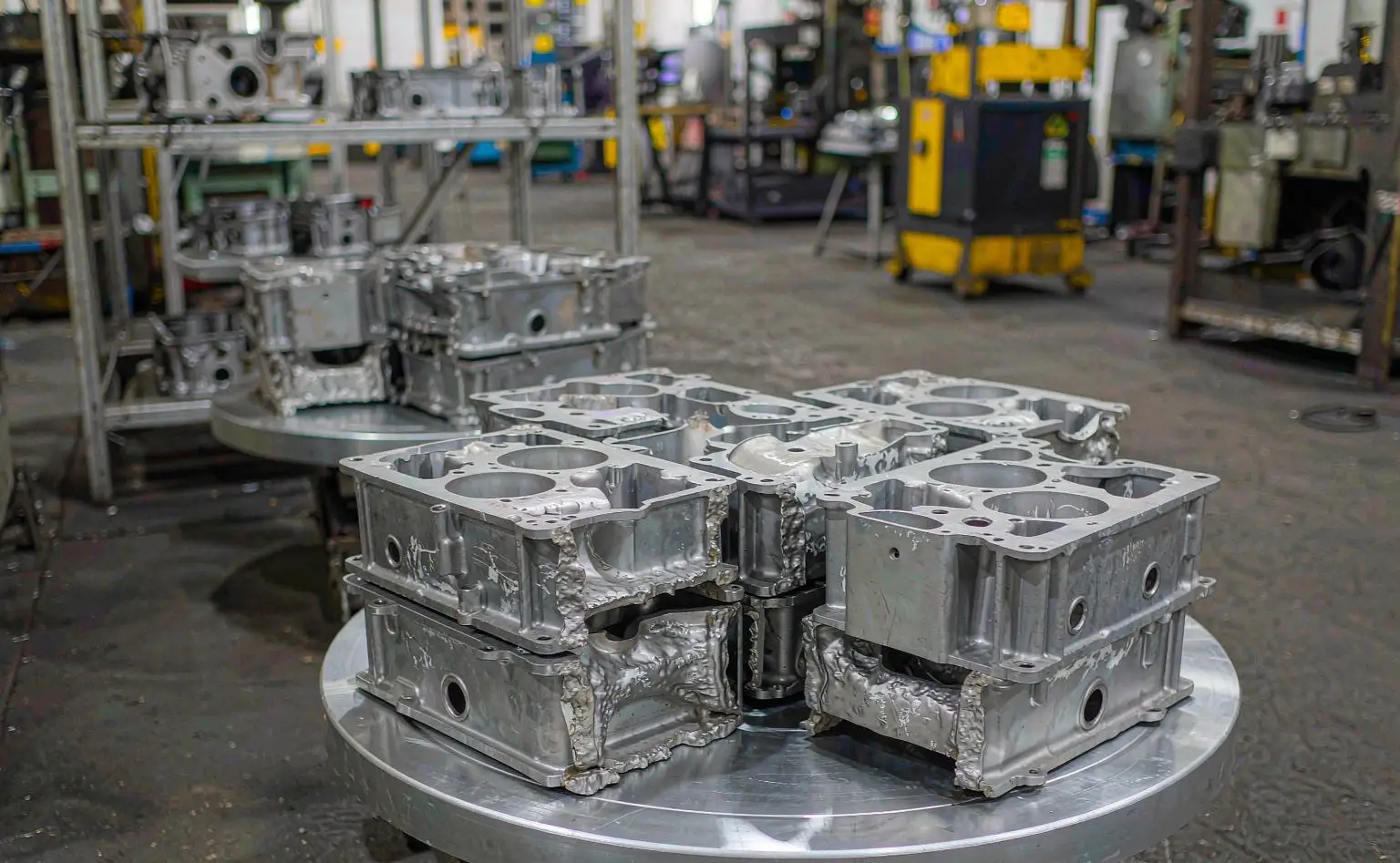
1. Where the growth comes from: release agent, coolant, wet parts
Release agent is the first residue. Die release agents are mostly water-based emulsions. Where they are sprayed heavy they leave an organic film on the cold face of the die, and the casting comes out carrying it. That film holds both water and oil, and it is a ready carbon source.
Coolant and wash liquor stack on top. Machining coolant carries fatty acids and emulsifiers. If the wash after machining is not thorough, residue stays in pockets, threaded holes and recesses, and the two residues together are where spotting starts.
Wet parts go into the tote. Shot blasting is followed by an air blast or a wet dust extractor, and the parts leave the line damp. Dropped straight into a tote, water collects at the bottom overnight, and the whole tote is damp by the next morning.
Mould comes first, rust follows. These are not two problems. The mould layer holds moisture, and rust starts underneath the spots. By the time rust is visible, growth has been running for over a week. So the audit follows water, not rust.
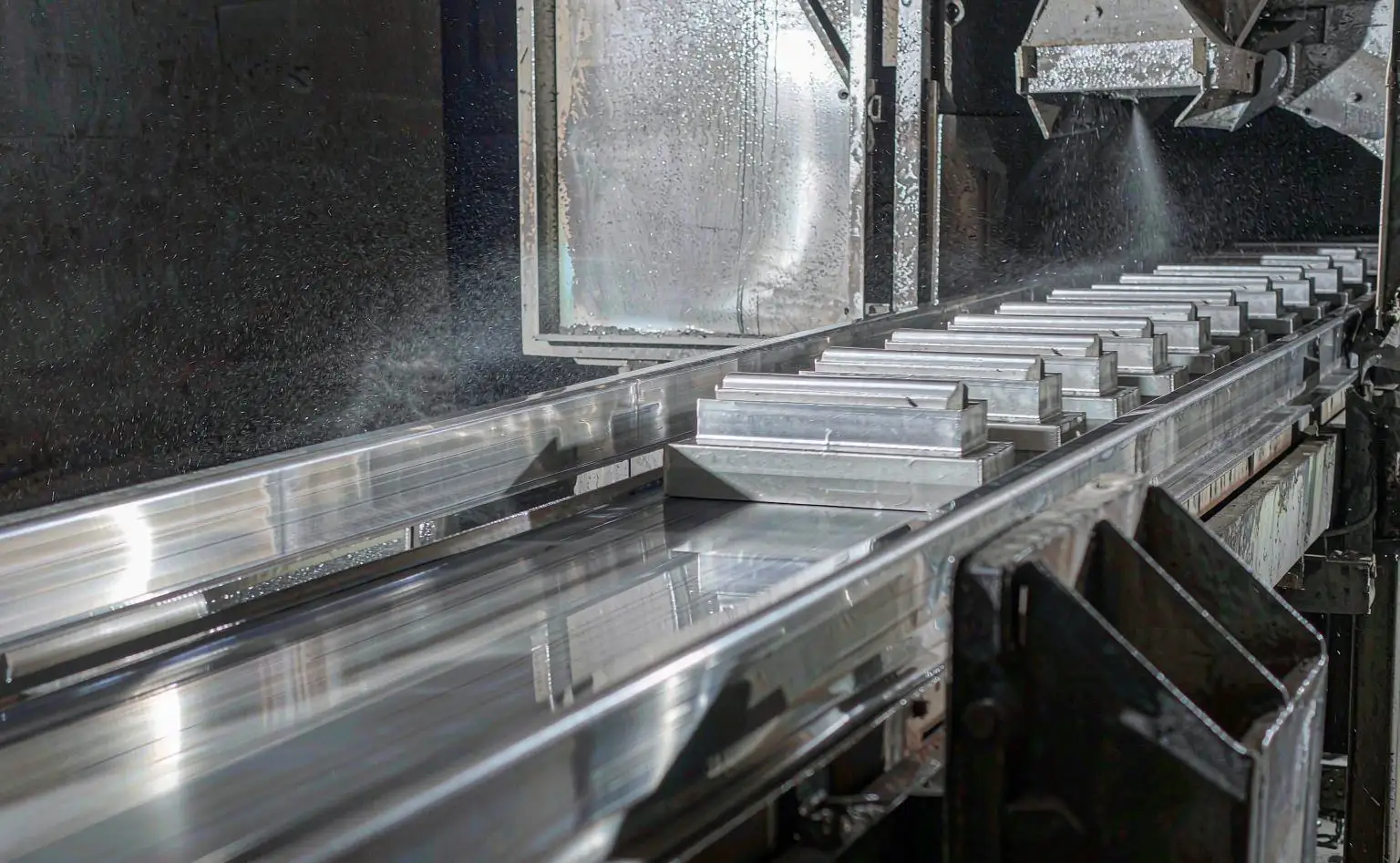
2. After blasting: dry first, then the tote
Temperature and time. Run the parts through an oven or a drying tunnel after blasting: bring the surface to 60-80°C and hold for 20-30 minutes so water leaves the blind holes and threads. Thin-wall parts take the lower temperature with a longer hold. Do not hit them with high heat, because a distorted casting is harder to rework than a spotted one.
Blow the holes out first. Before the oven, blow blind holes, threads and recesses with dry compressed air at 0.4-0.6 MPa. Going straight into the oven traps water at the bottom of a hole, and the parts come out of the tunnel still wet.
Boxing hot parts undoes the drying. Let the parts fall below 40°C before they go into a tote, and line the bottom with dry corrugated board or a plastic sheet. Box a hot part and the air inside condenses as it cools, which is the same water coming back.
The tote itself has to be dry. Plastic totes washed and not wiped hold water along the ribs. Turn them out and wipe them at every shift handover; it costs less than any additive.
3. Machined faces: wash first, oil second
Wash before oiling. Coolant residue on a machined face has to be washed off and dried before the rust-preventive oil goes on. Oil over residue seals the water in, and both mould and rust start under the film.
Keep the film continuous. Dip or brush the oil, and touch up threads and blind holes separately. A break in the film is a doorway for moisture, and it is where the first spots appear.
Do not over-oil. A heavy film runs and pools in summer, and the pool collects dust and water together. Hold the film to the process card: thin and even beats thick and pooled.
Treat bare and coated faces differently. Unpassivated bare aluminium takes up water fastest and should be boxed with sheets first. Painted or powder-coated parts matter at the edges and cut faces, and a damaged coating is treated as a bare face. Comparable metal packing practice is in fastener cartons and drying rods and hardware tools with overmoulded handles.
| Stage | Condition | Product and level | Process | Control point |
|---|---|---|---|---|
| After blasting | Wet, clean surface | No additive | Air blast, then 60-80°C dry | No water in blind holes, not hot to touch |
| Machined faces | Coolant residue | No additive | Wash, dry, oil | Continuous film, threads touched up |
| Tote | Internal air, floor | iHeir-D 0.1-0.2 g per sheet, 1-2 per tote | Bottom and top when boxing | Sheet not against a bare face |
| Wooden export crate | Sealed volume | As above, sheets by volume | Placed before closing | Moisture film inside, seams taped |
| Sea container | Container air | T-1000 8-10 sticks per 20 ft | Hung on the walls after loading | Not under cargo, doors closed tight |
One boundary. Drying and the oil film handle water on the part, sheets handle the air inside a box, sticks handle humidity across a container. The order cannot be swapped: sheet a part that is still wet and the sheet is spent before the voyage starts.
4. Boxing and shipping: how many sheets, how many sticks
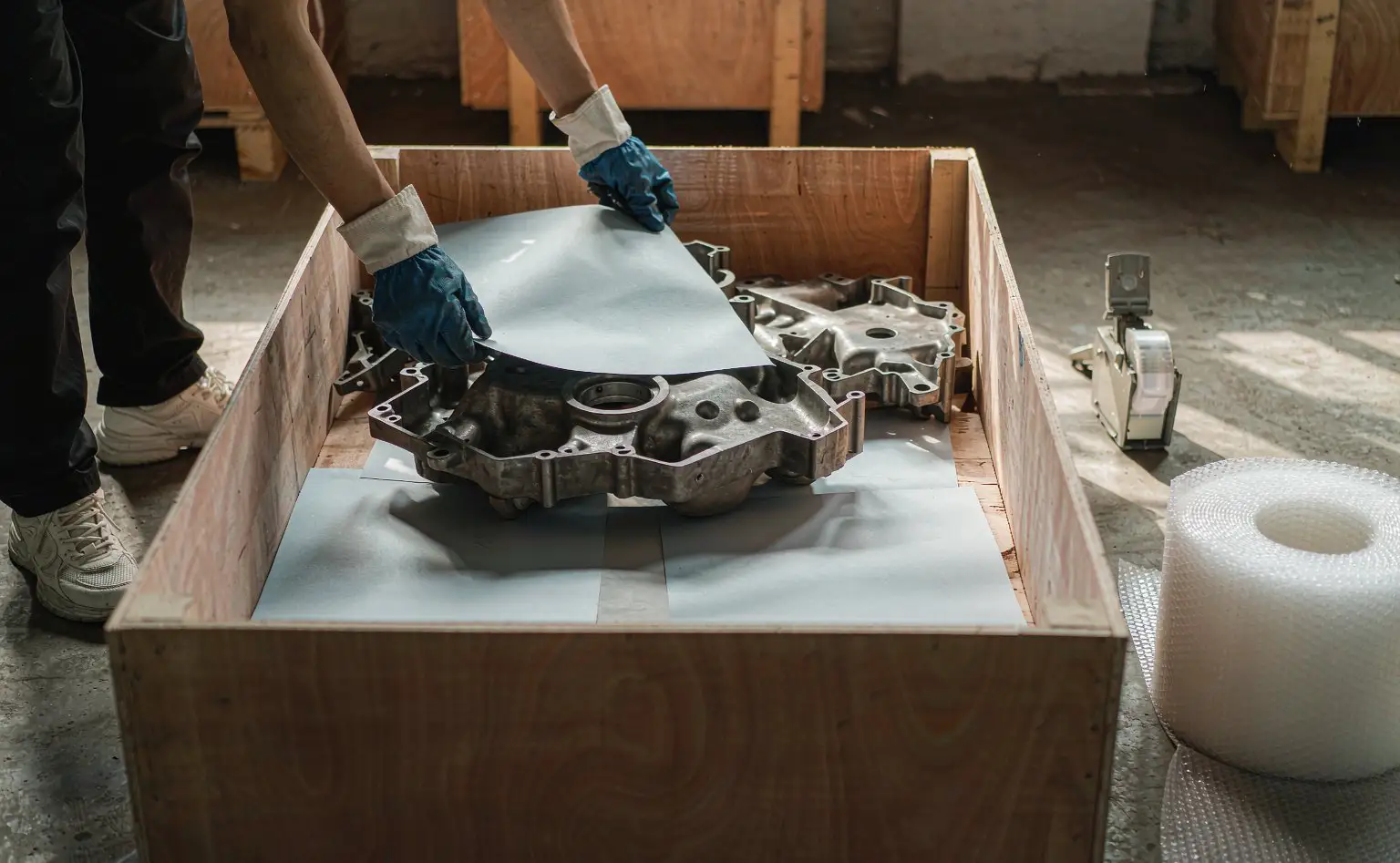
Sheets per box, not per tonne. Each iHeir-D sheet carries 0.1-0.2 g of active. A standard 60×40×30 cm tote takes 1-2 sheets, one at the bottom and one at the top. Double the internal volume and you add one sheet; do not scale by weight.
Keep sheets off machined faces. The product page warns of corrosion on poor-quality metal parts in damp conditions. Put a neutral board or bubble film between sheet and bare face, and tape the sheet to the wall or lid so it works by diffusion rather than contact.
Sticks by container size. T-1000 is a mineral adsorbent with no chloride and a neutral pH, so it does not attack metal. Use 8-10 sticks in a 20 ft container and 10-12 in a 40 ft, hung on both walls in a staggered pattern rather than piled at the door.
Run a compatibility test. Three times the normal sheet rate, sealed in a bag with a sample part, 3-5 days at room temperature, then check for darkening, tackiness or colour shift. Precision mating faces and mirror finishes must have this test; the cost of getting it wrong is the whole batch.
5. Common failures: the four places water gets back in
Boxed while still warm. The air inside condenses as it cools, and the sheets and sticks spend themselves on that water.
A wet tote. Washed and not wiped, a puddle at the bottom defeats any amount of sheeting. In the wet season this single point accounts for more than half of the rework.
No moisture barrier in the crate. Wood above 18% moisture content is a water source. Check incoming crates, dry the boards or line the crate with a moisture film.
Sticks in the wrong place. Sticks taped behind the doors and buried by cargo leave the far end of the container untreated, and the last boxes spot first. Space them along the length.
6. Questions from the plant
Q: Castings are metal, so why do they grow mould?
A: The metal does not. Growth sits on release agent, coolant and wash residue, and on the paper trays and timber inside the box. Spots mean organic residue plus water.
Q: Will blasting not remove the mould?
A: It removes what is on the surface, but wet parts boxed straight after blasting spot again within a week. Drying after the blaster matters more than any additive.
Q: Do the sheets attack machined faces?
A: The product page warns of corrosion on poor-quality metal parts in damp conditions. Keep sheets off bare faces, run the three-times compatibility test, and use physical dehumidification for precision parts.
Q: How many sticks does a container need?
A: 8-10 for a 20 ft and 10-12 for a 40 ft is the recommendation, but route and destination humidity move it. Ship in the rainy season or load damp cargo and you go to the top of the range, after logging humidity in the container once.
Blow the blind holes out with dry air, dry at 60-80°C for 20-30 minutes after blasting and box below 40°C; wash, dry and oil machined faces with a continuous film and touch up threads; use 1-2 iHeir-D sheets at 0.1-0.2 g per tote with a board between sheet and bare face; hang 8-10 T-1000 sticks in a 20 ft and 10-12 in a 40 ft; run a three-times compatibility test on precision parts. Levels and lead times are on the iHeir-D product page.


